


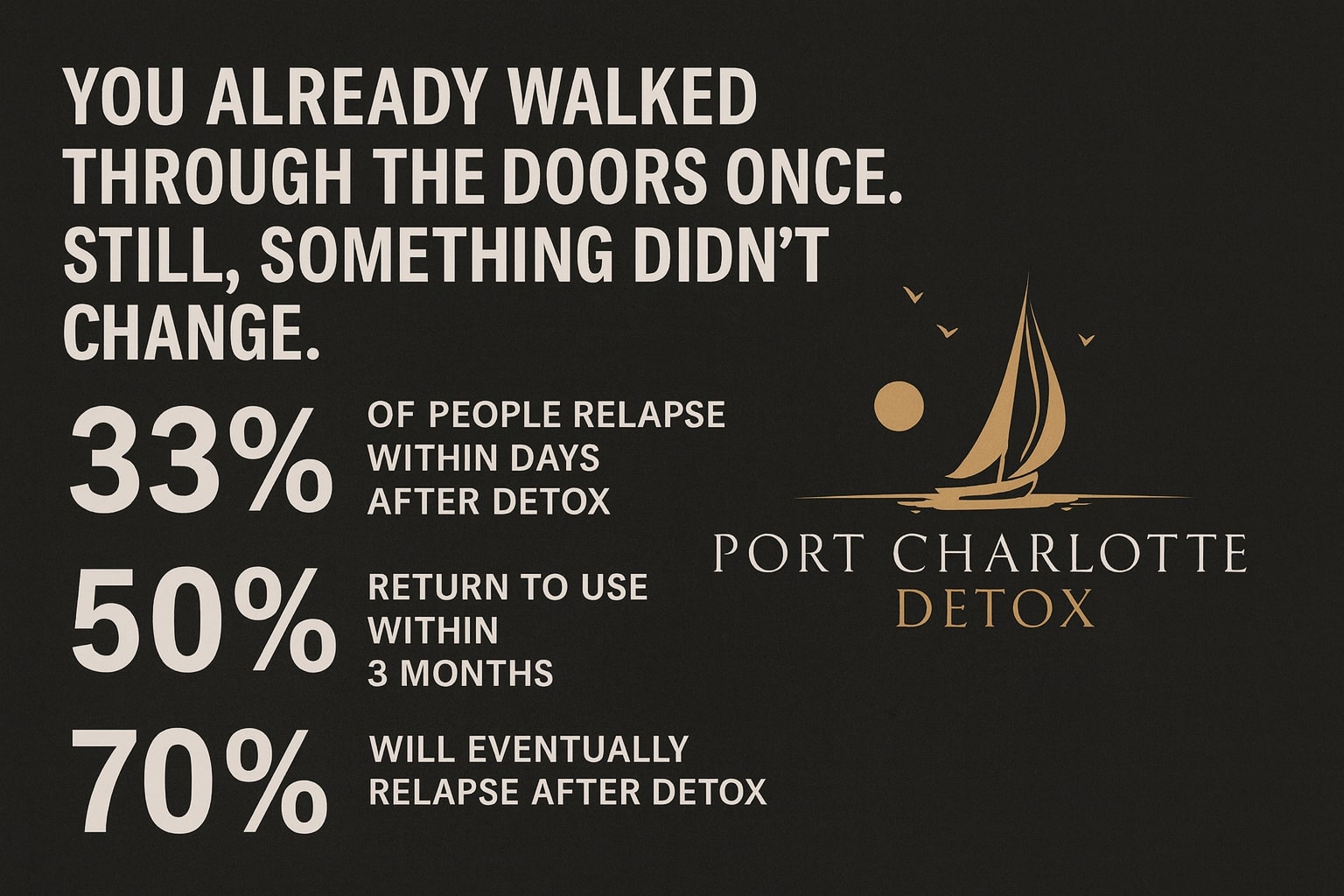
You already walked through the doors once. Maybe you sweated it out in a hospital bed or white-knuckled it in a facility that promised more than it delivered. Maybe you left thinking, “That was hell, but it’s over.”
But here you are again, staring at the same reality—and questioning if another alcohol detox program could possibly make a difference.
We talk to people every day who feel this way.
They’re not naive. They’ve been through it before.
And that’s exactly why we listen closely. Because if you’re still struggling, it’s not your fault for needing detox again. It’s a sign something deeper needs to shift.
Here’s what that can look like in an Alcohol Detox Program in Port Charlotte, Florida.
If Treatment Didn’t Help Before, It Doesn’t Mean You’re Hopeless
It’s one of the hardest feelings to admit:
“I went to detox. I tried. But nothing really changed.”
What often gets missed is this—detox isn’t recovery. It’s the reset button. The safety gate. The starting line, not the whole race.
The truth? Many people relapse after their first detox. Some go back to using within days. Some never stop completely.
But that doesn’t mean detox is useless. It might mean:
- The care you got wasn’t matched to your body or mental health needs
- You didn’t feel emotionally safe or respected during withdrawal
- No one helped you plan for what comes after detox
- You didn’t feel ready, and no one asked why
If detox didn’t “work” last time, let’s stop blaming you—and start looking at what needs to change in the process.
Detox Is Medical Care—Not a Moral Test
There’s this quiet belief a lot of people carry:
“If I have to detox again, I must have failed.”
Let’s be clear: that’s shame talking. Not science.
When your body is dependent on alcohol, detox is medically necessary. Just like you wouldn’t tell someone with pneumonia to “try harder” after a relapse in symptoms, you don’t tell someone with alcohol withdrawal risk to “just stop drinking.” You treat the body first. Then you treat the brain and behavior.
At Port Charlotte Detox, alcohol detox is treated like the medical event it is:
- 24/7 supervision by licensed clinical and medical staff
- Individualized protocols based on age, medical history, and past detox experiences
- Medication support to reduce the risk of seizures, DTs, or dangerous withdrawal symptoms
- Nutritional and hydration strategies to replenish depleted systems
- Trauma-informed care to reduce fear, judgment, and emotional harm during detox
You’re not weak for needing medical help. You’re responsible for seeking it again when it’s needed. That’s strength.
Your Body Might Not Detox the Same Way Twice
Here’s something most people don’t hear:
Just because you’ve done detox once doesn’t mean your next one will look—or feel—the same.
Alcohol withdrawal is unpredictable. It’s affected by:
- How long you’ve been drinking
- How heavily you’ve been drinking
- Your overall physical health
- Co-occurring conditions (like anxiety, depression, or chronic illness)
- Past trauma or nervous system sensitivity
In some cases, second-time detox is harder. The body may be weaker, or the withdrawal symptoms may accelerate.
In other cases, it’s easier—because you know what to expect and are more willing to accept support.
That’s why individualized detox matters. You deserve a team that adjusts with you, not just follows a script.
That’s what our Alcohol Detox Program in Charlotte County is built to provide.
This Time, It’s Not About Starting Over—It’s About Starting Deeper
For many returning clients, the fear is this: “I don’t want to go through all that pain again just to end up back here.”
We hear you.
That’s why your next detox shouldn’t be about checking a box—it should be a turning point. That starts with:
- More comprehensive medical and psychiatric assessment
- A clearer plan for what happens after stabilization
- Integrated conversations about trauma, shame, or past experiences with treatment
- Real conversations about relapse, support, and what worked—even a little—last time
And for some, it means accepting that detox is part of the long game. Not a one-time fix.
Just like managing diabetes or heart disease, you might need touchpoints of care over time—not because you’re broken, but because recovery is layered.
“I Was Embarrassed to Go Back. But They Treated Me Like a Human.”
“The first detox I did was court-ordered. I hated every minute. I felt judged, sick, and alone. When I started drinking again, I didn’t tell anyone. I figured no one cared. But when I called Port Charlotte Detox, they didn’t lecture me. They just asked if I was safe. That changed everything.”
– Former Client, 2023
These aren’t rare stories. And they don’t end with failure.
They begin again—with better care, and more honest expectations.
Where You Go Matters (So Does Who Treats You)
Not all detox centers are created equal.
Some are transactional.
Some are trauma-informed.
Some offer five-star environments but miss the emotional work.
Some are clinical but forget the human underneath.
At Port Charlotte Detox, we work to be all three:
Clinically sound. Emotionally safe. Human-first.
Our Alcohol Detox Program serves not just Port Charlotte, but clients seeking treatment from Fort Myers, Sarasota, and across Southwest Florida.
We offer private rooms, high-quality nutrition, medication-assisted detox where appropriate, and real planning for what comes next—whether that’s residential treatment, outpatient care, or medically safe transport to your home state.
You’re Allowed to Come Back. You’re Allowed to Need More.
If no one’s said this to you yet, let us be the first:
- You’re not weak.
- You’re not broken.
- You’re not disqualified from help because you didn’t get it right the first time.
Recovery doesn’t punish relapsers. It invites them back. That includes you.
FAQs: Alcohol Detox Program for Returning Clients
What if I’ve relapsed multiple times? Will detox still help?
Yes. Every time you detox, it gives your body and brain a chance to reset. It also gives clinicians another opportunity to identify what else may be affecting your recovery—trauma, mental health needs, support gaps, or medical complications.
How long does alcohol detox take the second time?
It varies. Most alcohol detox programs last between 5–10 days. If this is your second or third detox, we’ll assess how your withdrawal symptoms are presenting and adjust accordingly. Some people stabilize faster. Others may need more time or additional supports.
Is it safe to detox at home if I’ve done it before?
No. Alcohol withdrawal can be life-threatening—especially after relapse or repeated use. Symptoms like seizures, hallucinations, or delirium tremens (DTs) can escalate quickly. Always detox under medical supervision.
What comes after detox?
That depends on your needs. Some clients step into a residential or inpatient program. Others return home with outpatient support, medication, or therapy. We’ll work with you to create a plan that’s safe, practical, and matched to your goals.
What if I’m ashamed to come back?
That’s normal. But it’s also not necessary. You’re not alone. Most of our returning clients feel this way—until they walk through our doors and realize they’re welcomed, not judged.
It’s Not Just About Detoxing Again—It’s About Doing It Differently
If you’ve read this far, you’re already doing the hardest part: reconsidering what recovery might still hold for you.
This time doesn’t have to look like last time.
This time, you get to ask for care that fits.
This time, you don’t have to pretend to be more hopeful than you are.
You just have to be willing to try again—with people who won’t hold the past against you.
Call (844)336-2690 to learn more about our Alcohol Detox Program services in Port Charlotte, Florida.