


Some of us hit detox like a crash. Others slid into it quietly.
You might’ve walked in feeling like a wreck—or maybe like someone who kept it together until you just couldn’t anymore. Either way, detox got you through the worst of it. You cleaned up. Cleared your head. Put time between you and the substances that were slowly stealing your life.
But now? You’re stable. Maybe even respected. Life looks better from the outside.
So why does it feel so flat?
Detox Gets You Physically Clear—But That’s Not the Same as Okay
There’s no denying the importance of detox. Without it, most of us wouldn’t be here. Medically supervised withdrawal is what helped your body get back to baseline—and it was probably the first time in a long time you truly rested.
But detox doesn’t do emotional rewiring.
It doesn’t fix the relational damage, the spiritual disconnection, or the long-forgotten grief that floats up once the dust settles. And maybe no one told you that would happen. Maybe they said, “Just get through detox and the rest gets easier.”
Except it didn’t. Not really. Not for you.
Long-Term Recovery Doesn’t Always Feel Good
No one talks enough about the gray space that comes after early recovery.
In the beginning, everything felt urgent. Every day without using was a win. The support was immediate. The milestones were everywhere—first week, first month, first 90 days. You were focused. Anchored. In community.
Then life started up again. Work. Family. Dishes. Bills. And slowly, the recovery “high” faded.
Now, you’re functioning. You’re technically doing well. But you feel distant from yourself. Disconnected from the fire that carried you through the early days. And you’re scared to say it out loud because… what if it sounds like you’re ungrateful?
You Didn’t Do It Wrong. You Just Need More.
That stuckness? That sense of “is this all there is?”—it doesn’t mean you failed. It doesn’t mean detox didn’t work or that something’s broken in you.
It means your recovery is evolving.
Needing more support after detox, or after the first year, doesn’t mean you missed something. It means you’re ready for deeper work. And that’s a good thing. You’ve cleared the surface chaos—now the real self gets a chance to speak up.
Detox Was the Beginning, Not the Blueprint
At Port Charlotte Detox, our drug detox program is designed to safely guide people through withdrawal and into clarity. But we’ve been doing this long enough to know: clarity doesn’t equal peace.
Here’s what detox can do:
- Stabilize your body
- Ease acute cravings
- Offer rest, safety, and medical supervision
- Help you begin the process of healing
But here’s what detox can’t do on its own:
- Teach you how to navigate grief, boredom, or intimacy without substances
- Help you understand why you needed to numb out in the first place
- Build a fulfilling, sustainable life beyond survival
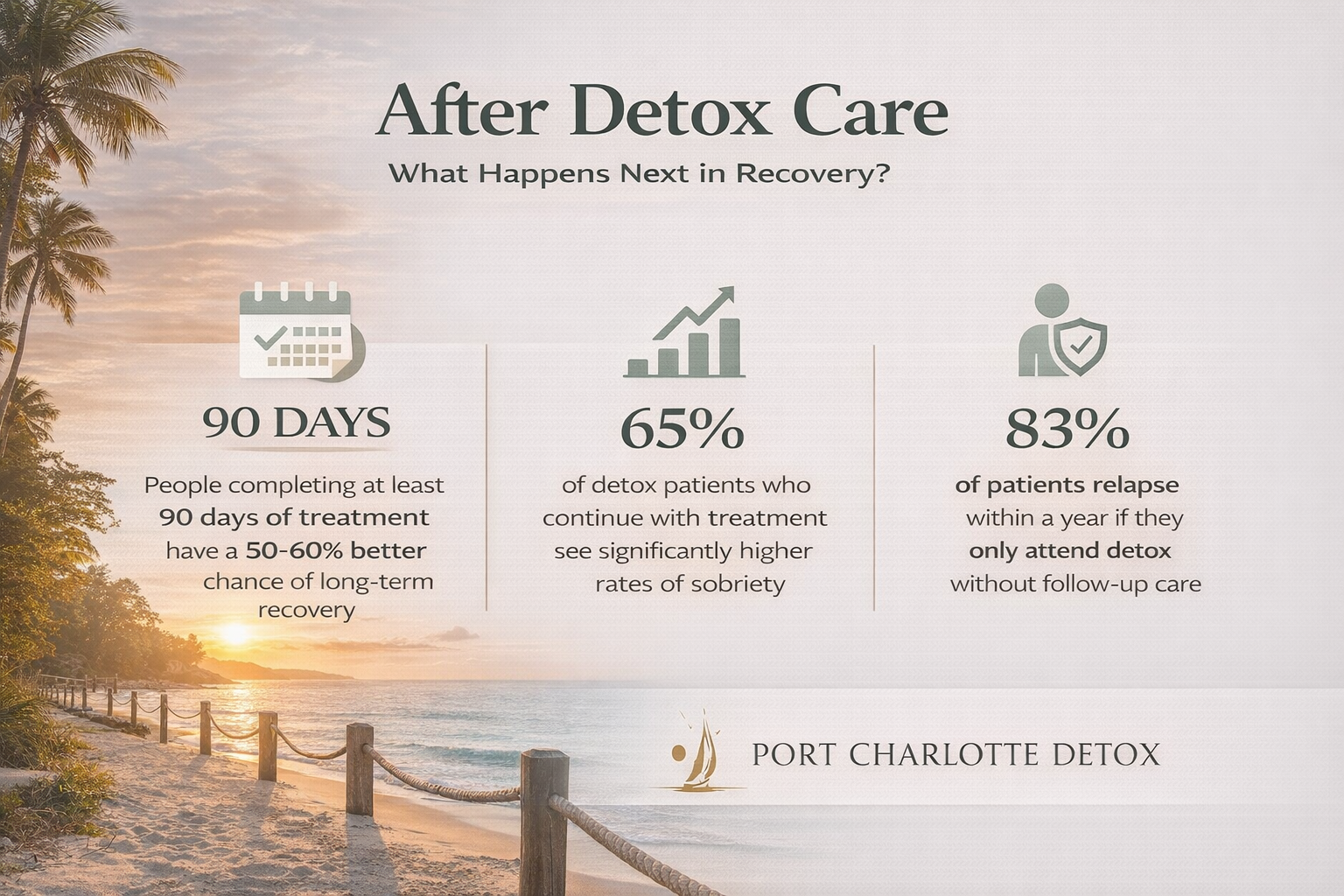
For that, you need continued care. And more importantly—you need space to admit you still need something.
The Mid-Recovery Plateau Is Real
You’re not imagining it. There is a point in recovery—often a year or more in—when the fire dims.
You’re no longer chasing sobriety with the same intensity. The external threats are quieter. But so is the excitement. What’s left can feel… mechanical. Repetitive. Emotionally thin.
And it’s here, in this flattening, where many people start to second-guess themselves:
- Shouldn’t I be happier by now?
- Why does everything feel so muted?
- Do I even belong in meetings anymore?
- Is it okay to say I’m not okay, even though I’m “doing well”?
Yes. Yes, it is.
There’s No Expiration Date on Needing Support
One of the most dangerous myths in recovery is that once you hit a certain milestone—six months, a year, five years—you should be fine.
But recovery isn’t linear. It’s layered. And healing isn’t just about not using—it’s about reconnecting with life in a way that feels real again.
That might mean:
- Revisiting therapy
- Exploring trauma that was too raw to face early on
- Re-engaging with community support in new ways
- Joining a short-term outpatient or alumni track
- Telling someone—honestly—that you’re spiritually tired
At Port Charlotte Detox, we walk with people long after detox. Because detox clears the fog. But what comes next builds the life.
“I Didn’t Relapse. But I Felt Like I Disappeared.”
A 2022 alumni told us something that stuck:
“I didn’t relapse. I didn’t lose anything. But I felt like I disappeared. Like I was sober and stable—but emotionally… gone. I didn’t know I could ask for more support without starting from zero.”
That’s what happens when we don’t talk about the middle. People stay silent. They assume they’re the only ones. They white-knuckle through the flatness, hoping it will pass.
It doesn’t have to be like that.
A Second Season of Support Can Change Everything
There’s no rule that says you only get one shot at treatment. In fact, many of the most transformative breakthroughs happen in what we call the “second season” of recovery—the part that begins after detox, after the first milestones, and after the performance of being “okay” wears off.
This is where:
- Grief comes up
- Joy gets redefined
- Spiritual hunger returns
- Identity questions get louder
- Life asks you to engage with more than just sobriety
And if you’re feeling that nudge, you don’t need permission to follow it. But just in case—here it is anyway: you’re allowed to want more.
FAQs: Long-Term Recovery & Post-Detox Support
Is it normal to feel disconnected after the first year?
Yes. Many people experience a plateau after the early structure fades. You’re not broken. You’re just ready for a new kind of growth.
Does this mean my detox didn’t work?
No. Detox did its job: it stabilized your body and cleared your system. Emotional and spiritual work often comes later—and that’s okay.
Do I have to go back to rehab?
Not necessarily. Many long-term alumni benefit from short-term outpatient work, alumni tracks, trauma-focused therapy, or spiritual direction. It’s not about starting over. It’s about going deeper.
Is it okay to say I’m not okay, even if I’m sober?
Yes. Sobriety is not the same as wellness. You can be sober and still feel lonely, stuck, or hollow. That doesn’t mean you failed—it means you’re human.
Can Port Charlotte help even if I detoxed years ago?
Absolutely. Whether you worked with us before or not, we can help you explore next steps that meet you where you are now—not just where you started.
You Don’t Have to Settle for “Fine”
If you’ve been stuck in the emotional middle of recovery, here’s the most important thing we can say:
This isn’t all there is.
You don’t have to stay flat. You don’t have to pretend. And you don’t have to keep quiet just because everyone assumes you’ve got it handled.
We see you. We’ve been there. And we believe your recovery deserves to keep growing.
Call (844)336-2690 or visit Port Charlotte Detox’s drug detox program, serving Charlotte County, FL, Near Fort Myers & Lee County, FL to learn more about our support for long-term alumni and next-step care. Let’s talk about what healing looks like now.