


You don’t have to be sure.
You don’t need the right words.
And you’re not wrong for noticing something has changed.
If you’re reading this, you’re likely watching someone you care about—partner, sibling, parent, child—and quietly wondering: Is this still okay? Or is it time to get help?
The truth is, most families never get a clear line in the sand. There’s no dramatic movie moment. Instead, there are a thousand tiny shifts—some you can explain, some you just feel.
So if your gut says something’s not right, let’s honor that. Let’s talk about what medical detox really is, how it supports someone physically and emotionally, and how you can begin moving from fear to clarity.
At Port Charlotte Detox, we know that noticing the signs is the first act of love. It doesn’t make you paranoid. It means you care enough to pay attention.
Detox Isn’t Just for “Rock Bottom” Moments
Let’s start here: medical detox isn’t just for people who’ve lost everything.
Many people in active addiction still show up for work, manage kids, and handle responsibilities. From the outside, things may still look functional. But inside? They’re in pain. Or exhausted. Or using just to keep going.
Medical detox isn’t about judgment or labels. It’s a short-term medical service that safely manages withdrawal, stabilizes the body, and creates a foundation for healing.
Waiting for a crisis before helping someone access detox doesn’t make things easier. It just makes the pain last longer.
1. They Feel Sick or Anxious When They Try to Cut Back
This is one of the biggest and most overlooked signs of physical dependence.
If your loved one has tried to stop or slow down—but couldn’t—listen closely. They may have experienced:
- Shakiness or trembling
- Sweating or chills
- Headaches, nausea, or vomiting
- Intense anxiety or restlessness
- Trouble sleeping for multiple nights in a row
- Agitation, confusion, or even paranoia
These are common withdrawal symptoms. And depending on the substance (especially alcohol, opioids, and benzos), they can be dangerous—or even deadly—without medical support.
Detox is designed to keep this process safe.
2. They Use to “Feel Normal”—Not to Feel High
There’s a point where substance use stops being about pleasure—and starts being about survival. You might notice your loved one isn’t chasing a high anymore. Instead, they’re just trying to feel “normal.”
This could look like:
- Needing a drink to stop shaking in the morning
- Popping pills just to show up to work
- Taking something before social events to “get through it”
- Drinking or using earlier in the day than they used to
When the body relies on a substance just to stabilize, detox becomes a medical necessity—not a moral failing.
3. They’ve Changed—Even If You Can’t Name Exactly How
Dependency doesn’t always look chaotic. Sometimes, it looks like emotional distance. Numbness. Irritability. Avoidance.
You might notice:
- A short fuse or unpredictable mood swings
- Avoiding eye contact or being present during conversations
- Sleep changes—either constant fatigue or insomnia
- More time spent alone or outside the usual routines
- A general “checked out” feeling, even during important moments
This isn’t “bad behavior.” It’s often the nervous system struggling under the weight of substance dependence. Detox can help restore emotional regulation, clarity, and connection—but only if we can name that something’s wrong.
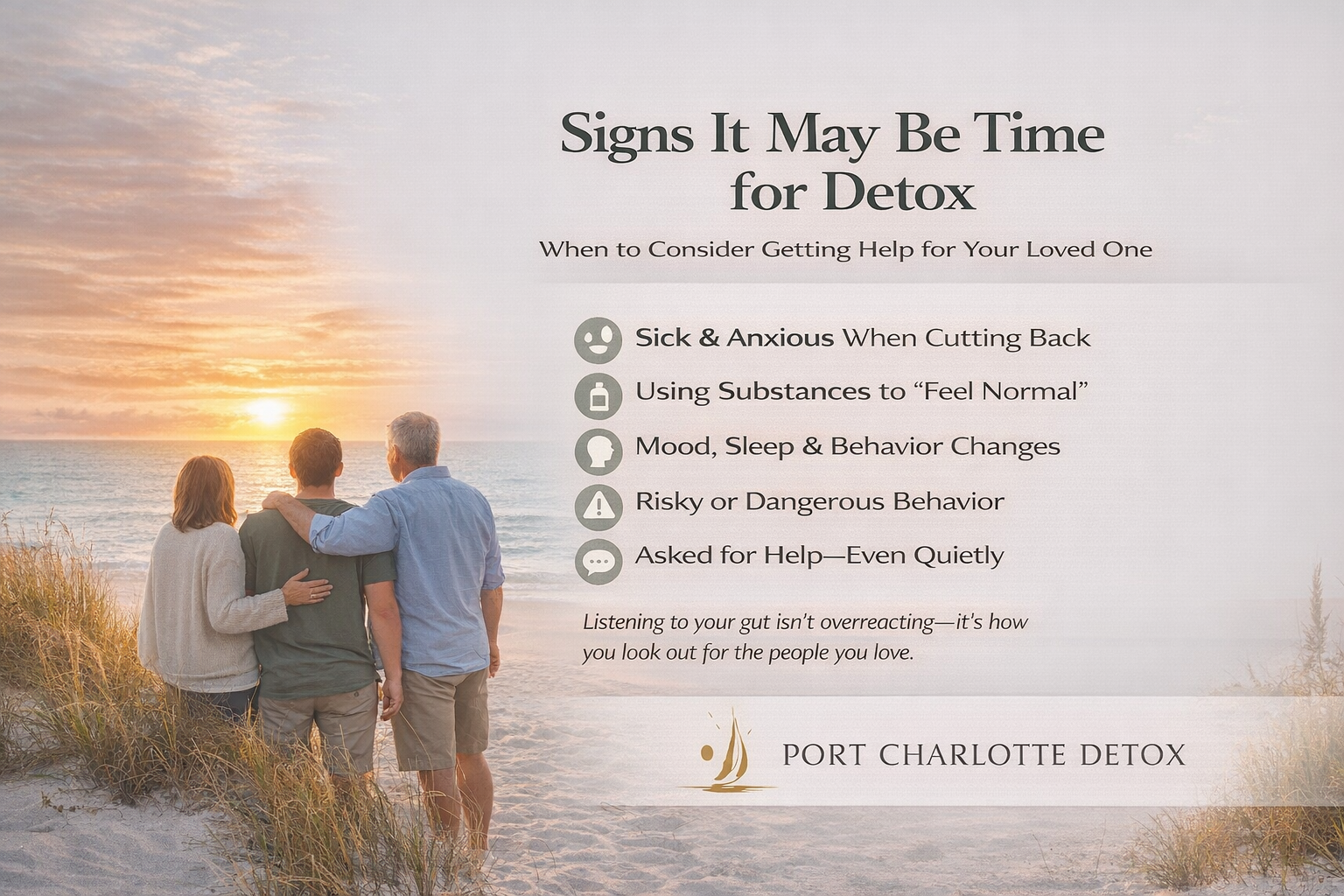
4. Risky Behavior Is Becoming the Norm
High-risk patterns don’t always start big. Often, they escalate slowly. You might notice:
- Driving under the influence—“I’m fine, I’ve done this before.”
- Mixing substances (alcohol + pills, uppers + downers)
- Running out of prescriptions early and “borrowing” from others
- Hiding bottles, stashes, or paraphernalia
- Being vague or defensive about how much they’ve used
Even if these moments are infrequent, they point to something deeper. If safety is being compromised—even occasionally—it’s a sign that the brain’s reward system is overriding logic. That’s a biological shift, not a personality flaw.
Medical detox can help reset the body so decision-making becomes possible again.
5. You’ve Heard the Quiet Ask
This is the moment we want to highlight the most.
Sometimes, your loved one has already asked for help. But not in the way you expected.
It might’ve sounded like:
- “I think I need a break.”
- “I can’t do this anymore.”
- “I’m scared of what’s going to happen.”
- “I tried quitting, but I couldn’t sleep. I felt crazy.”
- “I don’t even get drunk/high anymore. I just feel numb.”
These aren’t dramatic cries for help—but they’re real.
Acknowledge them. Lean into the moment. Share information gently. You don’t have to have all the answers—you just have to stay open when the door cracks.
Medical Detox Can Be a Gentle Beginning
If you’re wondering whether detox is too intense, here’s the truth: medical detox is often more gentle and supportive than people think.
At Port Charlotte Detox, detox isn’t punishment—it’s protection. Our team provides:
- 24/7 medical monitoring and safety
- Medication-assisted support for comfort
- Quiet, compassionate care in a private setting
- Planning for what comes next—not just a discharge
Whether someone needs full residential care after, or just space to think clearly again, detox creates that space.
Learn more about our drug detox program and how we help families move from fear to focus—step by step.
FAQs: Medical Detox & Loved Ones
Can I bring up detox without sounding accusatory?
Yes. Try focusing on concern, not blame. Say: “I’ve noticed you’re not feeling like yourself. I found this place that helps with withdrawal safely—can we look at it together?”
What if they’re still “high functioning”?
Many people in need of detox maintain jobs, families, and social lives. Functioning doesn’t cancel out dependence. If they’re using to get through the day, that’s enough reason to consider help.
How long does detox take?
Typically 5–10 days, depending on the substance and individual health. Some people transition into further treatment, while others return home with aftercare support.
What substances require medical detox?
Alcohol, benzodiazepines (like Xanax), opioids (like heroin, fentanyl, or Oxy), and certain stimulants may require detox. The safest way to know is to call and ask.
Can I call even if they’re not ready?
Absolutely. We talk to family members every day. You don’t have to wait for them to agree. Getting information for yourself is a powerful first step.
You Don’t Need to Be an Expert—You Just Need to Care
You’re not supposed to have this all figured out. But you are allowed to trust your gut.
If something in your loved one feels off—if they’re using more, suffering more, or pulling away—it’s okay to speak up. You’re not overreacting. You’re reaching out.
Let us walk with you from this first question to the next right step.
Call (844)336-2690 or visit drug detox program in Southwest Florida, serving Charlotte County, FL, & Lee County, FL to learn more about how we help individuals and families start safely.
You don’t have to wait for a crisis. You can start with a conversation.