


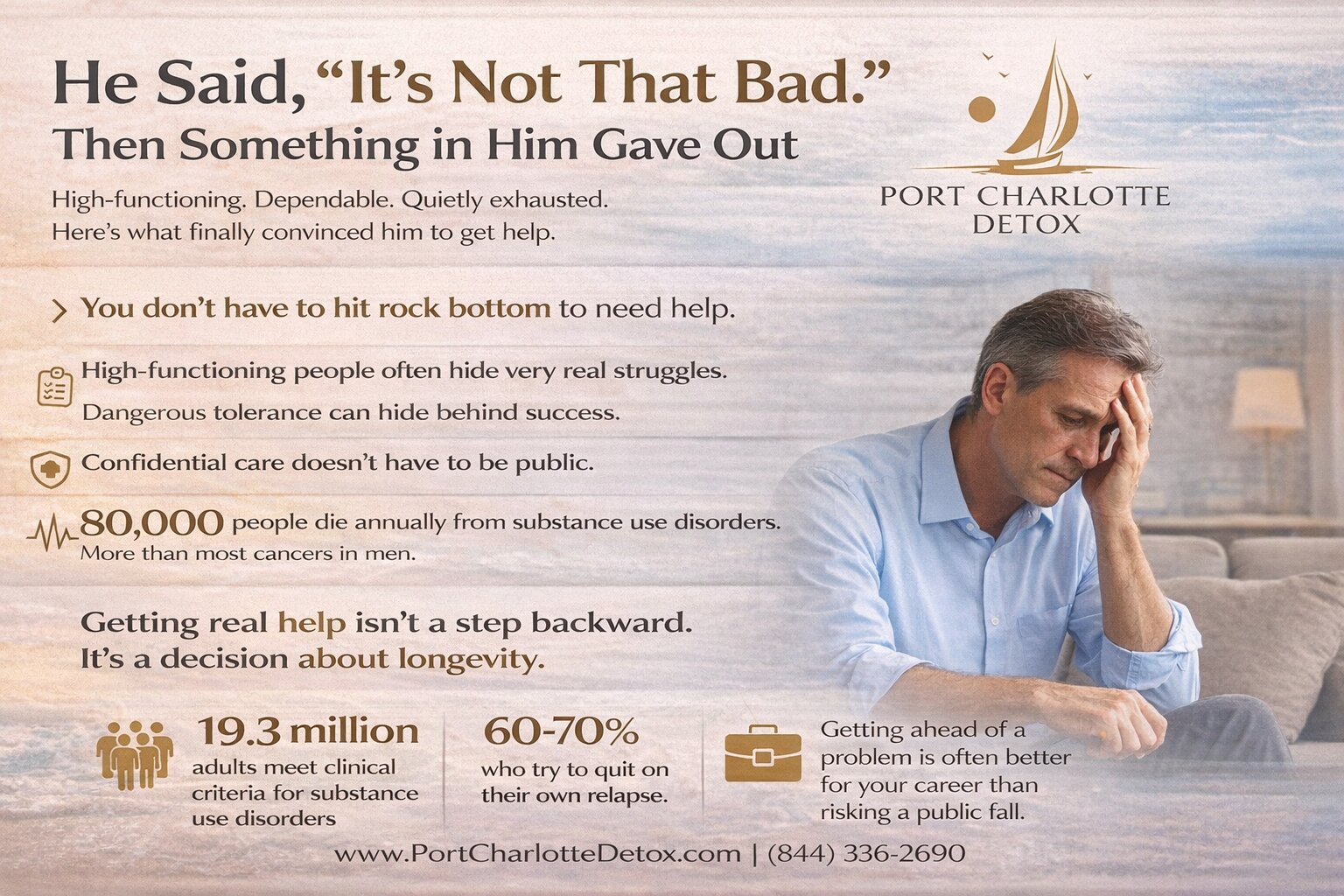
He sat in my office in pressed slacks and a collared shirt.
On time. Polite. Composed.
“I mean… it’s not that bad,” he said. “I’m still handling everything.”
From the outside, that was true. He ran a business. Coached his son’s team. Paid his bills. No DUIs. No dramatic scenes.
But his eyes were tired in a way that sleep doesn’t fix.
And before he ever walked through our doors, he had already spent late nights researching our drug detox program. He just couldn’t reconcile the word “detox” with the image he had of himself.
High-functioning people rarely walk in because everything collapsed.
They walk in because something inside them finally does.
The Myth of “If It Was Worse, I’d Go”
High-functioning addiction hides behind comparison.
“I’m not missing work.”
“I’m not drinking in the morning.”
“I’ve never been arrested.”
“I’m not like the people you see on TV.”
That mental checklist becomes a shield.
But here’s what I’ve learned as a clinician: the absence of visible chaos does not mean the absence of harm.
Sometimes the damage is internal.
- Elevated blood pressure.
- Worsening anxiety.
- Shaky hands in the morning.
- Increasing tolerance.
- Irritability your family feels but doesn’t name.
- A constant mental negotiation about when you can use next.
You can be productive and still be physically dependent.
You can be admired and still feel trapped.
The question isn’t, “Is it bad enough?”
The question is, “Are you free?”
The Exhaustion No One Sees
When you’re high-functioning, the heaviest burden isn’t always the substance.
It’s the performance.
The constant calibration:
- Did anyone notice?
- Do I smell like it?
- Did I say too much?
- Can I drive?
- How much do I have left?
It becomes a second job. A background app running all day, draining your battery.
One of the most honest things he said that day was this:
“I’m just tired of thinking about it.”
That’s usually the turning point.
Not rock bottom.
Mental fatigue.
The kind that makes you realize you haven’t felt fully clear in years.
Quiet Signs You May Be Closer to a Breaking Point
You don’t have to be falling apart to be struggling.
You might recognize yourself here:
- You’ve tried to cut back more than once — and it didn’t last.
- You use more than you tell people.
- You feel anxious, sweaty, nauseous, or shaky when you don’t.
- You build your schedule around when you can use privately.
- You feel a flash of defensiveness when someone brings it up.
- You promise yourself you’ll “reset” after this week… every week.
High-functioning people are good at pushing through discomfort.
But withdrawal isn’t a willpower issue.
It’s physiological.
And once physical dependence sets in, white-knuckling becomes riskier — and harder — than most expect.
What He Was Really Afraid Of
When we dug a little deeper, his resistance wasn’t about whether he needed help.
It was about what it meant.
“If I go to detox,” he asked, “does that mean I’m an addict?”
Underneath that question was something more vulnerable:
“Does that mean I’ve failed?”
High-functioning professionals often attach their identity to competence.
Admitting loss of control in one area can feel like an identity threat across all areas.
But here’s what I told him:
Needing medical support to come off a substance safely is not a moral statement. It’s a health decision.
If someone has chest pain, they don’t debate whether they “deserve” a cardiologist.
They go.
Substance dependence deserves the same clarity.
The Reality of Physical Dependence
One of the biggest misconceptions I see is this:
“If I can still function, I can just taper on my own.”
Sometimes that works.
Often, it doesn’t.
Depending on the substance, withdrawal can involve:
- Severe anxiety or panic
- Insomnia that stretches for days
- Nausea and vomiting
- Blood pressure spikes
- Seizures (in some cases)
- Intense cravings that override logic
This isn’t weakness.
It’s neurobiology.
Your brain adapts to regular substance use. When that substance is removed, your system has to recalibrate.
That recalibration is where many high-functioning individuals get blindsided.
They expect discomfort.
They don’t expect how persuasive their own brain becomes when it wants relief.
That’s why a structured setting with medical oversight changes everything. You’re not alone in it. Your body is supported while it stabilizes.
And your decision-making improves once you’re no longer in survival mode.
“But What About My Job?”
This is one of the most common concerns.
High-functioning professionals fear:
- Losing income
- Being replaced
- Colleagues finding out
- Long-term career damage
Here’s what’s often true:
Many employers are far more receptive to short-term medical leave than they are to long-term performance decline.
Substance use doesn’t stay static. It escalates.
Getting ahead of it protects your career far more than hiding it.
And treatment today doesn’t look like disappearing for six months without contact. There are ways to approach this discreetly, strategically, and with privacy protected.
You don’t have to burn your life down to rebuild it.
The Shift
There’s a moment I’ve witnessed hundreds of times.
It’s subtle.
The arguing stops.
The comparison stops.
The justifications run out.
And a person says something like:
“I don’t want to live like this anymore.”
That’s what he said.
Not dramatically.
Just honestly.
Choosing a drug detox program wasn’t about punishment or labels.
It was about relief.
About giving his nervous system a chance to reset.
About sleeping without waking up in panic.
About waking up without immediately calculating the day’s supply.
Within a week of stabilization, he said something that stays with me:
“I forgot what it felt like to think clearly.”
That’s what people underestimate.
Clarity.
It’s not dramatic.
It’s quiet.
And it’s powerful.
FAQ: Questions High-Functioning Clients Ask Before Reaching Out
Do I have to hit rock bottom before going to detox?
No. In fact, the earlier you intervene, the better your outcomes tend to be. Waiting for external consequences only increases risk — physically, professionally, and emotionally.
What if I’m not sure I’m “bad enough”?
Severity isn’t measured by how chaotic your life looks. If you’re physically dependent, unable to stop on your own, or afraid of withdrawal symptoms, that’s reason enough to seek medical support.
Will people find out?
Your care is confidential. There are privacy protections in place for medical treatment. Many people seek support without public disclosure, especially professionals and executives.
How long does detox take?
The timeline varies depending on the substance, how long you’ve been using, and your health history. Some people stabilize in several days. Others need a bit longer for safe monitoring. The goal isn’t speed. It’s safety and stabilization.
What happens after detox?
Detox addresses the physical component of dependence. What comes next depends on your needs — therapy, structured outpatient support, or other next steps. But here’s the key: You don’t have to decide all of that today. The first step is getting clear.
If You’re Quietly Wondering
High-functioning people often wait because they’re waiting for permission.
For a sign.
For things to get worse.
Consider this your sign instead:
You’re allowed to choose relief before collapse.
You’re allowed to take your health seriously — even if your life still looks “fine.”
You’re allowed to step out of the cycle before it takes more than you planned to give.
If something in this feels uncomfortably familiar, that discomfort is information.
Call 844-336-2690 or visit our Drug detox program services in Port Charlotte, Florida to learn more about your options.
You don’t have to wait until it’s “that bad.”
And you don’t have to keep carrying it alone. Serving Charlotte County, FL, & Lee County, FL.