


You’ve been sober for a while now.
Maybe a year. Maybe five. Maybe longer.
You did what once felt impossible. You walked through withdrawal. You rebuilt your routines. You repaired relationships. You learned how to sit with yourself without reaching for something to numb it.
So why does it feel like something’s missing?
If you’re a long-term alum feeling stuck or disconnected, this isn’t a failure. It’s not a secret desire to go backward. It’s often something quieter.
Sometimes, the next stage of growth starts by remembering the beginning — including the Drug detox program that helped you stabilize when everything felt out of control.
Let’s talk about why that matters.
Long-Term Sobriety Can Be Surprisingly Quiet
Early recovery is loud.
Your body is recalibrating. Your emotions are close to the surface. Every day feels like a decision. You’re hyper-aware of triggers, cravings, and progress.
Years later, it’s different.
You know how to live sober. You know how to function. You’ve built systems. You’ve learned language. You can spot red flags before they explode.
And that’s good.
But sometimes the intensity fades — and what replaces it feels… flat.
No chaos.
No crisis.
But also, not much spark.
You might find yourself thinking:
- “I should feel more grateful than this.”
- “Other people seem more excited about sobriety.”
- “Is this all there is?”
That quiet dissatisfaction can feel scary. Especially when you worked so hard to get here.
The Beginning Was Raw — and Real
Think back to those first days.
Detox wasn’t glamorous. It wasn’t inspirational. It was real.
You were probably exhausted. Maybe physically sick. Maybe emotionally wrecked. Maybe just numb and staring at a ceiling tile, wondering how life got so complicated.
There was no performance back then.
You weren’t trying to be the “strong alum.”
You weren’t quoting slogans.
You were just surviving.
That kind of honesty is rare. And it’s powerful.
When long-term recovery feels mechanical, remembering your drug detox program experience isn’t about reliving pain. It’s about reconnecting with the version of you who stopped pretending.
That person is still you.
Growth Doesn’t Always Feel Exciting
No one talks enough about this stage.
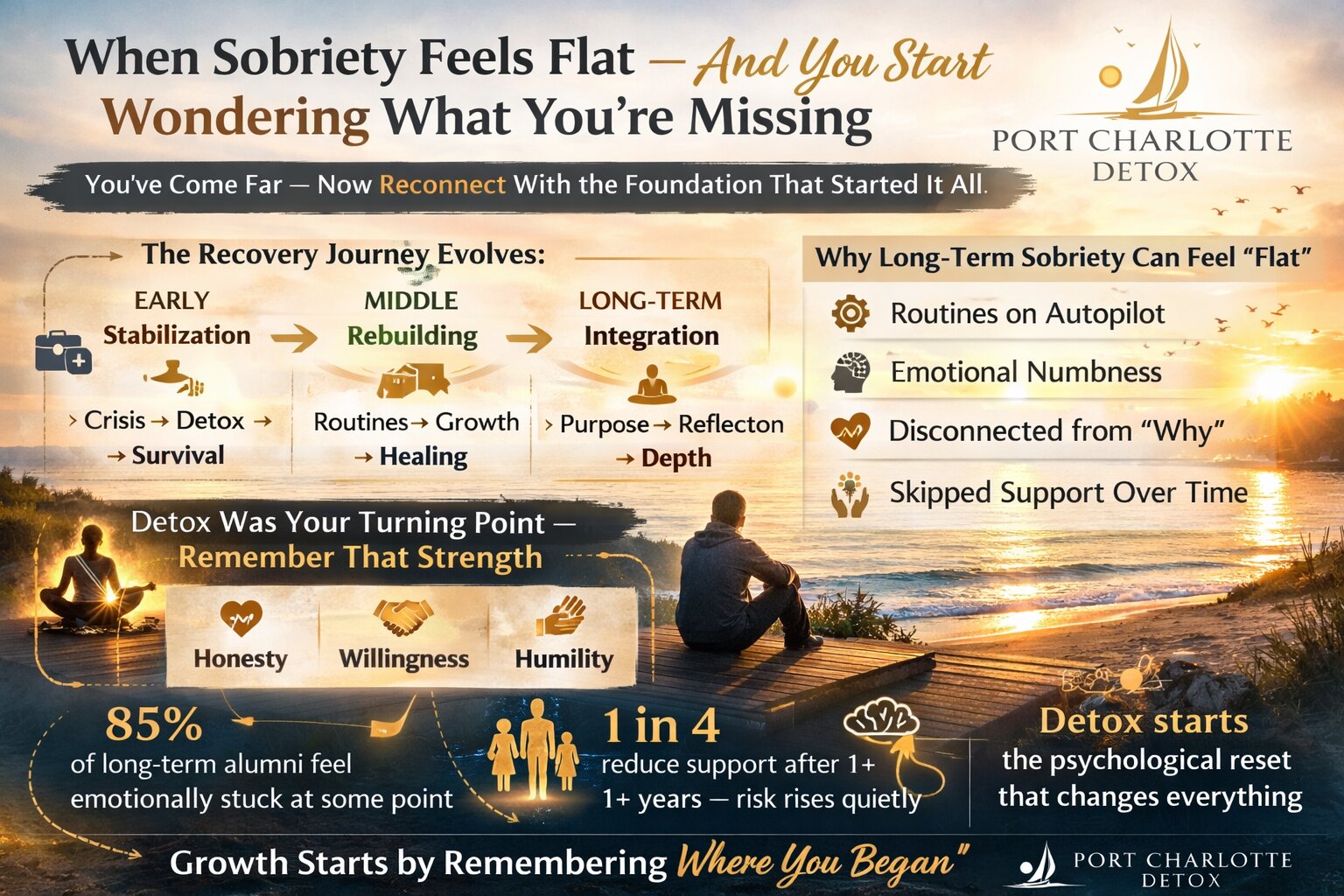
Early recovery is about stabilization.
Middle recovery is about rebuilding.
Long-term recovery? That’s about integration.
Integration is subtle. It’s less dramatic. It requires reflection instead of reaction.
And sometimes, integration feels like boredom.
But boredom isn’t emptiness. It’s space.
The problem is, if you don’t intentionally fill that space with purpose, it can slowly turn into disconnection.
You might start:
- Skipping meetings you once relied on
- Avoiding conversations about your early days
- Minimizing how hard detox actually was
- Telling yourself you “shouldn’t still need support”
That last one is dangerous.
Support doesn’t expire just because your sobriety date gets older.
Detox Was a Psychological Turning Point
A structured detox setting wasn’t just about clearing substances from your body.
It was a line in the sand.
It was the moment you said, “I can’t keep doing this.”
That choice matters more than you might realize.
When you first entered a detox program, you surrendered control in a way that felt terrifying. You trusted professionals. You allowed monitoring. You followed guidance.
You didn’t have all the answers — and you admitted it.
Years later, it’s easy to slide back into hyper-independence.
“I’ve got this.”
“I don’t need help.”
“I should know better by now.”
But the strength you showed in detox wasn’t independence. It was willingness.
Remembering that can be grounding.
You’re Not Supposed to Outgrow Your Foundation
Some alumni avoid thinking about detox because it feels like going backward.
It’s not backward. It’s foundational.
No one tells a person who built a house to “move past” the concrete slab. The house stands because the foundation holds.
Your detox experience was your foundation.
Even if you’ve done outpatient work, therapy, meetings, sponsorship, service — it started there.
When you feel disconnected now, you don’t need a dramatic overhaul. Sometimes you need a reset to your core values:
- Honesty
- Willingness
- Humility
- Openness
Those were loud in detox. They can get quiet over time.
But they’re still available.
Emotional Flatness Isn’t a Relapse — It’s a Signal
Let’s be clear.
Feeling disconnected doesn’t mean you’re about to use.
It means something inside you wants attention.
Long-term alumni sometimes confuse emotional stagnation with gratitude failure. You might think, “I should just be thankful. I’m sober.”
But gratitude and growth aren’t opposites.
You’re allowed to want depth.
You’re allowed to want meaning.
You’re allowed to want more than just “not using.”
Sometimes revisiting your detox story — even just mentally — can remind you how far you’ve come and what you were fighting for.
That perspective shift can reignite motivation without creating shame.
Reconnection Can Be Active
If you’re feeling flat, consider small, intentional steps:
- Re-read your early recovery journal entries
- Talk with another alum about detox memories
- Visit or reconnect with the center where you began
- Schedule a therapy session focused on long-term growth
- Reflect on what you were most afraid of losing — and what you’ve gained
You don’t have to wait until things fall apart to re-engage.
Sometimes the bravest move is saying, “I don’t want to drift.”
If your recovery began with medically supported stabilization, revisiting that chapter — or learning more about how it shaped your early sobriety — can provide surprising clarity.
You can explore the foundation that started your journey through our Drug detox program services and reflect on how those first steps continue to matter today.
FAQ: Long-Term Alumni & Reconnecting with Early Recovery
Is it normal to feel disconnected years into sobriety?
Yes. Long-term sobriety often shifts from crisis management to maintenance and meaning-making. Emotional flatness can happen when growth plateaus or routines become automatic. It doesn’t mean something is wrong. It means something is evolving.
Does feeling stuck mean I’m at risk of relapse?
Not automatically. But ignoring emotional stagnation can create vulnerability over time. Disconnection, isolation, and boredom are subtle warning signs — not emergencies, but signals to re-engage. Early intervention is strength, not weakness.
Why think about detox if I’ve already moved past that stage?
Because detox was a psychological reset. It marked your decision to stop surviving and start changing. Revisiting that memory can reconnect you with your original motivation and willingness. Foundations matter — especially when the structure above them feels shaky.
Should I reach back out to my original treatment center?
If you feel called to, yes. Many alumni reconnect for tours, check-ins, or simply to reflect. Re-engaging doesn’t mean you’re struggling. It can mean you’re committed to staying aligned.
What if I feel ashamed for not feeling “grateful enough”?
Long-term recovery isn’t a constant emotional high. You’re human. Emotional cycles continue. Wanting depth or renewed purpose doesn’t erase your gratitude — it deepens it.
You’re Allowed to Want More Than Stability
You didn’t walk through detox just to survive.
You walked through it to build a life.
If that life feels flat right now, it doesn’t mean you failed. It might mean you’re ready for the next layer of growth.
And sometimes, growth starts by remembering who you were when you said, “Enough.” Serving Charlotte County, FL & Lee County, FL.
If you’d like to reconnect with the foundation that started your recovery, call (844)336-2690 or visit our Drug detox program services to learn more about our Drug detox program services in Port Charlotte, Florida.