


You already know something has to change.
You wouldn’t be here if it didn’t.
But knowing you need help and actually walking into treatment are two very different things. The space between those two moments can feel massive — filled with fear, what-ifs, and questions you’re almost afraid to say out loud.
If you’re considering a drug detox program for the first time, this is for you. Not the polished version. The real one.
Let’s talk about what people wish they knew before they came in.
You Don’t Have to Be Certain — Just Willing
One of the biggest misconceptions about starting treatment is that you need to be completely sure.
Sure you’ll never use again.
Sure you’re ready to change your entire life.
Sure you won’t miss it.
That’s not how this works.
Most people who come to us are not certain. They’re exhausted. They’re scared. They’re done living the way they’ve been living — but they’re still unsure about what life looks like without substances.
You don’t need lifetime clarity. You need enough willingness to take the next step.
Recovery doesn’t start with confidence. It starts with honesty.
Withdrawal Is Managed — Not White-Knuckled
Let’s name the fear directly: withdrawal.
If you’ve tried to stop before and felt sick, shaky, anxious, or panicked, your body remembers. That memory alone can keep people stuck.
Detox today is not about “toughing it out.”
It’s medical stabilization. It’s monitoring. It’s symptom management. It’s trained professionals paying attention to what your body needs hour by hour.
You are not left alone to suffer. You are not expected to grit your teeth and prove anything.
The goal is safety and comfort — not punishment.
For many people, the experience is far more supported and structured than they imagined. That realization alone lowers anxiety within the first day.
The Emotional Crash Can Be Stronger Than the Physical One
Here’s something people don’t expect:
The first 24 hours can feel emotionally intense.
You might arrive with adrenaline — “Okay, I’m doing this.” Then it quiets. The reality settles in. There’s space. And that space can feel overwhelming.
Shame can surface. Regret can surface. Fear can surface.
You might think, What have I done?
Or, What if I can’t do this?
This is normal.
When substances leave your system, your emotions aren’t numbed anymore. That doesn’t mean you’re failing. It means your nervous system is recalibrating.
We expect that wave. We walk people through it every day.
And almost everyone who stays through that first emotional surge says the same thing later: “I’m glad I didn’t leave.”
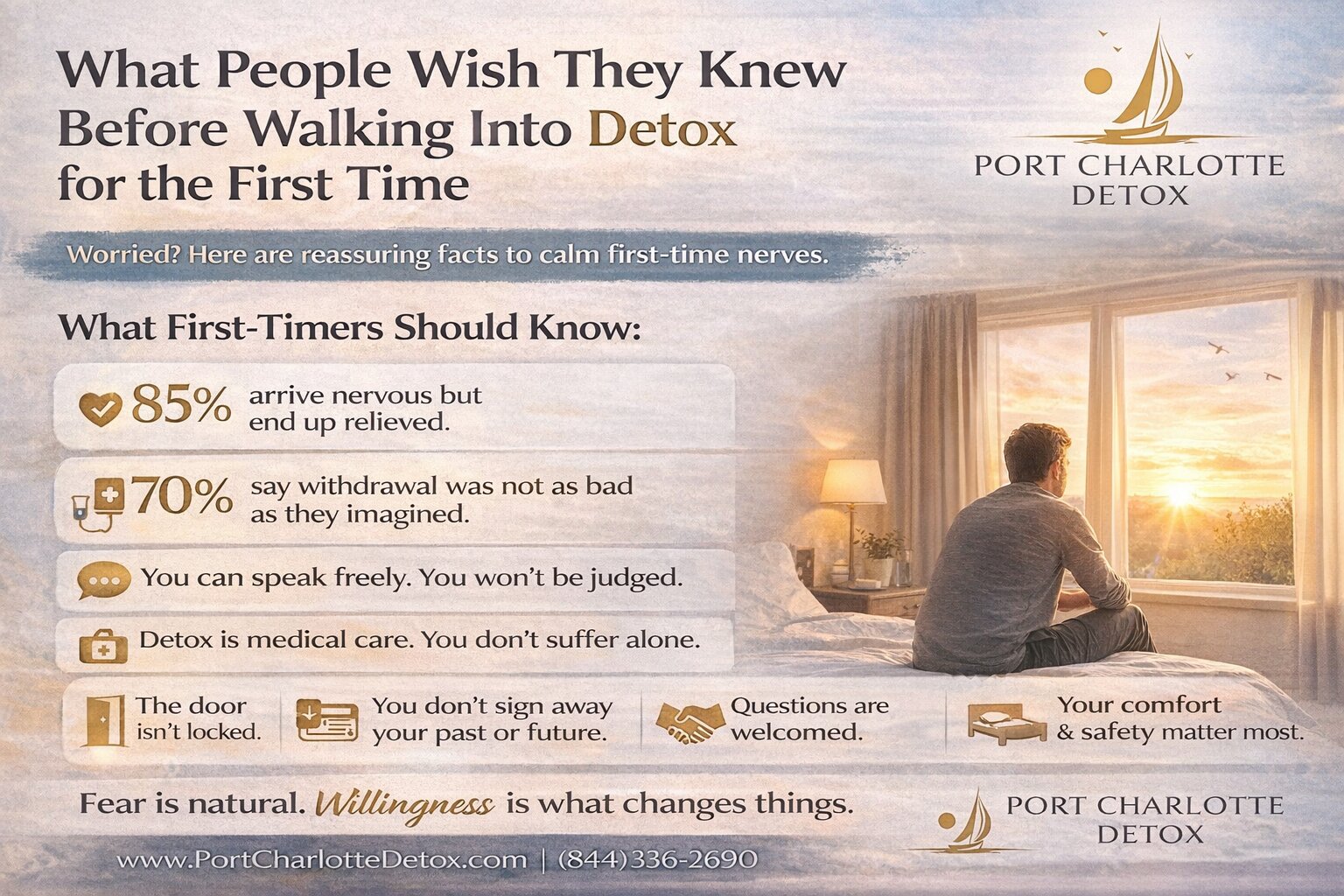
You Won’t Be Judged Here
Many first-time treatment seekers expect interrogation.
They expect to be asked, “Why did you let it get this bad?”
That’s not the energy here.
Addiction isn’t a character flaw. It’s not a lack of willpower. It’s not something you chose in a vacuum.
You don’t have to defend your story. You don’t have to compare yourself to someone “worse.” You don’t have to minimize what happened either.
You can tell the truth. All of it.
And you will be met with professionalism, not shame.
You Might Feel Relieved Faster Than You Expect
This surprises people.
After the fear of walking in… after the paperwork… after the initial assessment…
There’s often a moment.
A deep exhale.
Because for the first time in a long time, you’re not managing it alone.
You’re not planning your next use.
You’re not hiding symptoms.
You’re not calculating lies.
You’re just… here.
Relief doesn’t mean everything is fixed. It means you’re not carrying it by yourself anymore.
You Don’t Have to Be the “Strong One” Right Now
A lot of first-time clients are the dependable ones in their families. The provider. The caretaker. The high-functioning one.
They’re used to holding everything together.
Detox might be the first time in years you let yourself not be in control.
That can feel terrifying.
But it can also feel freeing.
There is strength in allowing yourself to receive help. There is courage in admitting you can’t white-knuckle this anymore.
You are not weak for being here. You are brave for being here.
Detox Is the Beginning — Not the Whole Plan
Detox is stabilization. It clears the fog. It helps your body regulate.
From there, you and your clinical team discuss next steps.
Some people transition into live-in treatment. Others step into structured daytime care. Others move into multi-day weekly treatment while returning home.
Nothing is forced.
But detox creates something essential: clarity.
And clarity makes decisions possible.
If you want to understand more about how this first stage works, you can explore what to expect in our drug detox program and how we guide people through those early days safely.
What If You’re Afraid It Won’t Work?
This one sits quietly in the background.
“What if I go through all of this… and I still relapse?”
That fear makes sense.
But here’s what detox actually does: it gives your brain and body a fighting chance.
Substances hijack your nervous system. Detox helps restore baseline function. It reduces physical dependence so therapy, support, and behavioral work can actually land.
It’s not magic. It’s medicine and structure.
And many people who once doubted whether change was possible are now living lives they couldn’t picture before walking in.
The first step rarely feels heroic. It feels vulnerable.
But vulnerability is often the doorway.
Frequently Asked Questions
How long does detox usually last?
Length varies depending on the substance, how long you’ve been using, your overall health, and how your body responds. For many people, the acute stabilization period lasts several days, though some symptoms may take longer to fully resolve. Your care team monitors progress daily and adjusts accordingly.
Will I be in pain?
Discomfort can happen, depending on the substance and level of dependence. However, medical support is designed to reduce symptoms as much as safely possible. Medications, hydration, rest, and monitoring all play a role in keeping you stable and as comfortable as possible.
You are not expected to suffer through it alone.
What should I bring with me?
Most facilities provide clear guidance before admission. Typically, you’ll bring comfortable clothing, basic toiletries (without alcohol content), identification, and any prescribed medications in their original bottles. It’s helpful to pack lightly.
Our admissions team can walk you through specifics so you don’t have to guess.
Can I leave if I change my mind?
You always maintain personal agency. That said, we strongly encourage people to speak with their clinical team before making any decisions — especially in the early emotional phase. Often, what feels unbearable in hour 12 feels manageable by day two with proper support.
Will my family be involved?
Family involvement depends on your preferences and clinical recommendations. With your consent, loved ones can receive updates and guidance. Many families benefit from education and support during this stage.
You are not required to involve anyone unless you choose to.
What happens after detox?
Before discharge, you’ll collaborate with your team on next steps. Continuing care might include residential treatment, structured daytime care, or outpatient therapy. Detox is about stabilization — ongoing support addresses the underlying patterns that led to substance use.
You won’t be handed a pamphlet and sent home without a plan.
What if I’ve never done treatment before?
That’s okay. Many people entering detox are first-timers. You won’t be expected to “know how this works.” Staff guide you through the process step by step. Questions are welcome. Fear is expected.
You don’t need experience. You need willingness.
If you’re standing on the edge of this decision, feeling scared but knowing something has to shift — that feeling matters.
You are not weak for being afraid. You are human.
And you don’t have to keep doing this alone. Serving Charlotte County, FL & Lee County, FL.
Call (844)336-2690 or visit our Drug detox program services in to learn more about our Drug detox program services in Port Charlotte, Florida.