


You thought you were past this.
Maybe there was treatment. Maybe there were promises. Maybe there was a stretch of stability that let you exhale. And now you’re seeing the signs again — the late nights, the defensiveness, the subtle shift in their eyes — and your chest tightens.
You’re not just scared about the drinking.
You’re scared about their future.
As a clinician who has sat across from many parents in this exact moment, I want to talk honestly about what alcohol does to a young adult brain — and why early support can still change the trajectory in powerful ways. If you’re looking for clarity about options like alcohol addiction treatment, understanding the brain piece first can help you move from panic to purpose.
The 20-Year-Old Brain Is Still Wiring Itself
At 20, your child’s brain is not fully developed.
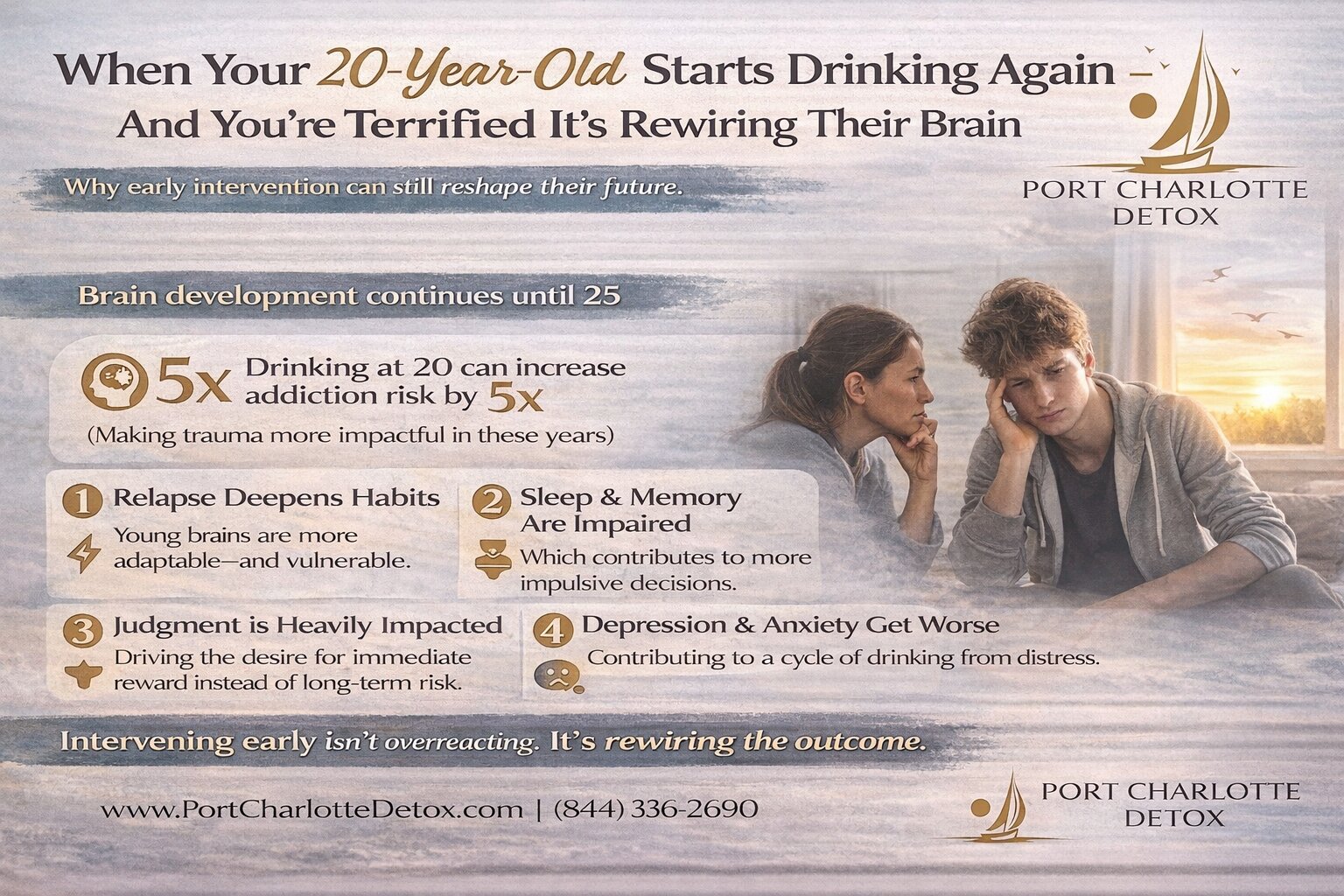
The prefrontal cortex — the area responsible for impulse control, long-term thinking, emotional regulation, and weighing consequences — continues maturing into the mid-20s. Meanwhile, the reward system (the part that responds to pleasure and relief) is highly active.
That imbalance matters.
It means the “feel good now” circuitry is strong, while the “is this wise long-term?” circuitry is still strengthening. Alcohol directly stimulates the reward system, flooding the brain with dopamine and temporarily dampening anxiety or distress.
When drinking becomes repetitive during this developmental window, the brain begins building shortcuts around it.
The brain is efficient. It wires what gets repeated.
If alcohol becomes the primary coping tool, those neural pathways deepen — sometimes quickly.
But here’s the hopeful part: a developing brain is also a flexible brain.
Why Relapse at 20 Isn’t the End — But It Is a Signal
Relapse can feel like a devastating step backward.
You might be thinking:
- We already did this.
- Why didn’t it stick?
- Did we miss something?
Relapse in young adults is common — not because treatment “failed,” but because the brain is still learning how to regulate stress, identity, and independence without substances.
At 20, life stressors often intensify:
- Academic pressure
- Social comparison
- Breakups
- Financial uncertainty
- The sudden freedom of adulthood
Alcohol offers quick relief in moments when emotional regulation skills are still fragile.
Relapse is not a moral collapse.
It’s information.
It tells us there are still vulnerabilities — and that the support plan may need to be adjusted, strengthened, or reintroduced earlier than you hoped.
Alcohol and Memory: The Quiet Impact Parents Don’t Always See
Many parents focus on behavior — the missed classes, the irritability, the hangovers.
But alcohol affects more than behavior.
Heavy or repeated drinking during young adulthood can interfere with:
- Working memory
- Attention span
- Emotional processing
- Sleep cycles
- Stress hormone regulation
Sleep disruption alone can amplify anxiety and depression, which then fuels more drinking. It becomes a feedback loop.
What looks like “laziness” is often neurological strain.
What looks like “not caring” can actually be a brain under pressure.
Understanding this doesn’t excuse harmful behavior — but it does reframe it. We are not just dealing with choices. We are dealing with brain adaptation.
The Power of Early Intervention
There’s a common fear among parents:
If we step in now, will we push them away?
The greater risk is waiting until patterns solidify.
When alcohol use continues during this developmental window, the brain increasingly links stress relief with drinking. But when drinking is interrupted — through structured support, clinical monitoring, therapy, or a medically supervised reset — those neural pathways can weaken.
Neuroplasticity works both ways.
I’ve seen 20-year-olds who were spiraling begin to stabilize within weeks of consistent support:
- Clearer thinking
- Improved sleep
- Reduced impulsivity
- Better emotional awareness
The earlier we intervene, the less entrenched the patterns become.
Early support is not dramatic. It’s preventative.
You Are Not Overreacting
Parents often minimize their intuition.
You might tell yourself:
- “Maybe it’s just a phase.”
- “Maybe I’m being controlling.”
- “Maybe this is normal.”
But if something feels different — if you see escalation, secrecy, or rapid emotional shifts — trust that instinct.
You know your child’s baseline.
You are allowed to act before catastrophe.
Intervening early does not require ultimatums or threats. It can begin with:
- A direct but calm conversation
- A clinical assessment
- Short-term structured care
- Addressing underlying anxiety or depression
Support does not equal punishment.
It signals protection.
This Is Not Your Parenting Report Card
Let me say something that parents rarely hear enough:
Your child’s drinking is not proof you failed.
Addiction risk involves genetics, brain chemistry, trauma exposure, mental health vulnerabilities, and developmental timing. Even attentive, loving, deeply involved parents cannot override every risk factor.
Love does not rewire dopamine pathways.
But love can help guide someone toward help before those pathways harden.
Your heartbreak is not evidence of failure.
It is evidence of attachment.
What Happens If We Wait?
It’s an uncomfortable question, but an important one.
If alcohol use escalates during this stage of brain development, we often see:
- Increased tolerance
- Riskier decision-making
- Greater emotional instability
- Academic or vocational disruption
- Stronger neural reinforcement of alcohol as coping
The longer the pattern continues, the more work it takes to untangle it later.
Early intervention is often shorter, less intensive, and less disruptive than waiting for crisis-level consequences.
When Mental Health and Alcohol Collide
Many 20-year-olds are not drinking purely for fun.
They are self-medicating:
- Social anxiety
- Depression
- Trauma
- ADHD
- Identity confusion
If underlying mental health concerns go untreated, alcohol becomes the substitute regulator.
Addressing both pieces — substance use and mental health — is often the turning point. It’s not about “just stopping drinking.” It’s about building internal regulation systems that make alcohol unnecessary.
That’s where thoughtful, developmentally aware care makes a difference.
Frequently Asked Questions Parents Ask
Is drinking at 20 always a sign of addiction?
Not necessarily. Some young adults experiment socially without developing a disorder. The concern rises when drinking becomes frequent, secretive, emotionally driven, or disruptive to functioning. Patterns matter more than isolated events.
Can brain changes from alcohol be reversed?
Many effects are reversible — especially in young adults. Sleep, cognition, and emotional stability often improve significantly after sustained abstinence and proper support. Early interruption increases the likelihood of full recovery.
How do I bring this up without pushing them away?
Stay calm. Focus on observations rather than accusations. Use “I” statements:
- “I’ve noticed you seem more stressed lately.”
- “I’m worried about how much you’re drinking.”
Avoid labeling. Invite conversation. If defensiveness rises, pause rather than escalate.
Should we wait until they ask for help?
Waiting can allow patterns to deepen. Even if they are ambivalent, an assessment or conversation with a professional can provide clarity. Motivation often grows after engagement begins — not before.
What if they’ve already relapsed once after treatment?
Relapse does not mean treatment won’t work again. It often means the initial level of support wasn’t sustained long enough or underlying issues weren’t fully addressed. Adjustments can make a difference.
How urgent is this, really?
If you’re seeing rapid escalation, blackouts, withdrawal symptoms, or severe mood shifts, urgency increases. If patterns are emerging but not yet severe, this is an ideal window for early intervention — when change is often easier.
You are not alone in this.
And your child is not doomed.
A 20-year-old brain is still forming — which means there is still room to reshape the story.
If you’re worried about how drinking is affecting your child’s development and future, you don’t have to navigate this fear by yourself. Call 844-336-2690 or visit our Alcohol addiction treatment services in to learn more about our Alcohol addiction treatment services in Port Charlotte, Florida.