


You’ve probably already had the thought: I can’t keep doing this.
But right behind it comes another one—louder, faster, and more convincing: What if getting help is worse?
That second voice is powerful. It’s built from half-truths, stories, and fear of the unknown. And for a lot of people, it’s the exact reason they wait longer than they need to.
If you’re here, you’re not in denial anymore. You’re just unsure what’s real—and what isn’t.
Early in that process, many people look into options like a live-in treatment setting and feel both hope and hesitation at the same time. That tension makes sense. Let’s slow it down and sort through what people often get wrong.
The Fear of Losing Control
A lot of people assume they’ll walk into something rigid and restrictive—like their life won’t belong to them anymore.
But here’s what often surprises them:
It’s not about taking control away from you. It’s about giving you a break from having to hold everything together alone.
Right now, control might feel exhausting. Constant decisions. Constant pressure. Constant internal negotiation.
Structure, in the right environment, doesn’t trap you. It steadies you. It creates space where your mind doesn’t have to fight itself every minute.
That’s not losing control. That’s finally getting support.
The Idea That You’ll Be Judged or Labeled
There’s a quiet fear that once you step into treatment, you’ll be seen differently. Reduced to a label. Judged for how you got here.
That fear keeps a lot of people stuck longer than they need to be.
But the reality is very different.
You’re walking into a space where people already understand that life is complicated. That pain doesn’t always look obvious. That coping can get messy.
No one is shocked by your story. No one is sitting there deciding if you “deserve” help.
You’re not being evaluated as a person. You’re being supported as one.
The Belief That Everyone Else Will Be “More Severe”
This thought shows up in a lot of different ways:
“I’m not that bad.”
“I don’t belong there.”
“I’ll be surrounded by people worse off than me.”
And underneath all of that is one core fear: I won’t fit.
But what most people actually experience is something unexpected.
Recognition.
Not in the details—but in the feeling.
The same exhaustion. The same mental loops. The same quiet moments where everything feels heavier than it should.
You don’t have to hit some invisible threshold to deserve help. If you’re struggling, that’s enough.
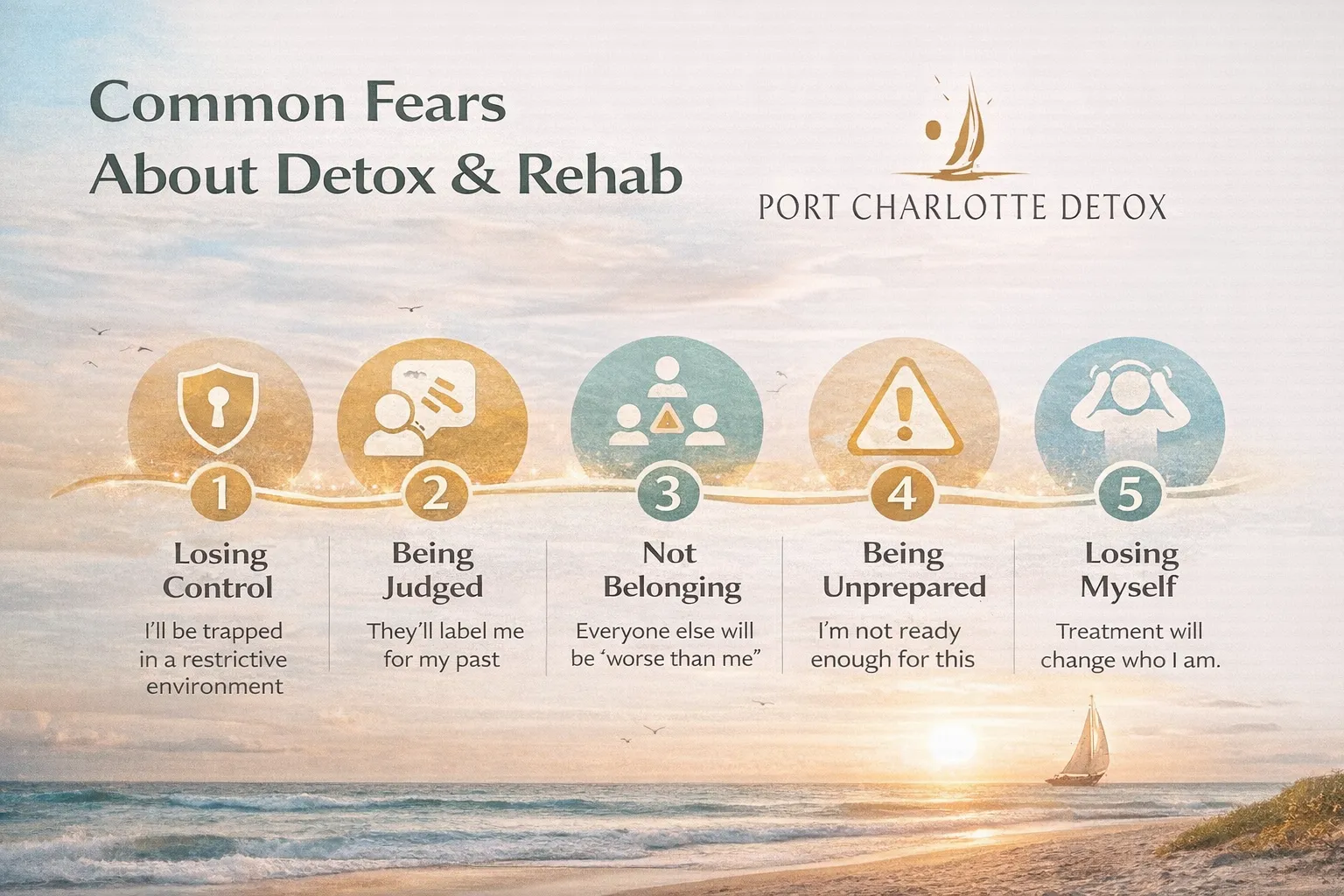
The Pressure to Be Fully Ready
It sounds responsible to say, “I’ll go when I’m ready.”
But readiness is one of the most misunderstood parts of this process.
Because if you’re waiting to feel completely sure, you might be waiting forever.
Most people don’t walk in feeling confident. They walk in unsure, guarded, and a little afraid.
And that’s okay.
You don’t need certainty. You need willingness—just enough to take one step.
Everything else builds from there.
The Fear That You’ll Lose Yourself
This one is deeper than most people admit.
“What if I’m not me anymore?”
“What if I feel flat, or different, or disconnected?”
It’s a real concern—especially if the way you’ve been coping has also been tied to how you relax, socialize, or even express yourself.
But what people often discover is the opposite of what they expected.
You don’t lose yourself.
You start finding parts of yourself that got buried under stress, pressure, or survival patterns.
It’s less about becoming someone new—and more about reconnecting with who you were before everything became so heavy.
The Worry That It Will Be Too Much to Handle
There’s a quiet fear that once you start, everything will come crashing down at once.
All the emotions. All the thoughts. All the things you’ve been avoiding.
That sounds overwhelming—because it would be.
But that’s not how this works.
You’re not asked to face everything in one moment.
You move through things gradually, at a pace that’s manageable. Supported. Guided.
Some days will feel heavier than others. That’s part of it.
But you won’t be doing it alone. And that changes everything.
What It Actually Feels Like for Most People
Not perfect. Not instant. Not easy every day.
But different in ways that matter.
People often describe a sense of relief they didn’t expect.
Not because everything is suddenly fixed—but because they’re not carrying it alone anymore.
There’s something powerful about waking up in a place where your only job is to focus on getting better.
No pretending. No performing. No holding it all together for everyone else.
Just space to breathe. Space to think. Space to start again.
For individuals seeking care in Charlotte County, Florida, that sense of stepping out of chaos and into something steady can feel like the first real pause they’ve had in a long time.
And for others navigating options in Lee County, Florida, it often becomes less about “fixing everything” and more about finally having the right support to begin.
The Quiet Truth People Discover
It’s not as scary as they imagined.
It’s not as harsh as they expected.
And it’s not something reserved for “other people.”
It’s for people who are tired. People who are trying. People who don’t want to keep living the same way but don’t know what comes next.
If that sounds like you, you’re not alone in it.
Not even close.
FAQs
How long does it take to start feeling better?
It’s different for everyone. Some people feel a sense of relief within the first few days simply because they’re in a more stable environment. Deeper changes take time—but small shifts often start sooner than expected.
What if I change my mind after starting?
That fear is more common than you think. The truth is, you’re not locked into anything forever. What matters is giving yourself a real chance to experience support before deciding it’s not for you.
Will I have any privacy?
Yes. While there is structure and community, there is also respect for your personal space, your story, and your pace. You’re never forced to share more than you’re ready to.
Do I need to have everything figured out before I go?
No. In fact, most people don’t. You don’t need a perfect plan—you just need to be open to starting the process.
What if I’ve tried to get better before and it didn’t work?
That doesn’t mean this won’t. Different environments, different support systems, and different timing can all change the experience. Past attempts don’t disqualify you—they inform what you might need now.
Is it normal to feel scared even if I know I need help?
Completely normal. Fear doesn’t mean you’re making the wrong decision. It usually means you’re stepping into something unfamiliar—and that’s where change begins.
A Final Thought
There’s a moment a lot of people have before they reach out.
It’s quiet. Not dramatic. Just a thought that lingers a little longer than usual:
Maybe I don’t have to keep living like this.
That thought matters.
You don’t have to have everything figured out. You don’t have to feel brave. You don’t even have to feel ready.
You just have to take one step toward something different.
Call (844)336-2690 or visit our treatment options in Southwest Florida to learn more about.