


Most people recognize loperamide by its brand name, Imodium. It’s a common over-the-counter medication used to treat diarrhea and is available without a prescription at nearly every pharmacy.
Because it is sold over the counter, many people assume it is harmless—even in large amounts. Unfortunately, that assumption has led some individuals to misuse loperamide in dangerous ways. If you’ve been searching about a loperamide high, you may have heard claims online that it can produce opioid-like effects or ease withdrawal symptoms.
Understanding what really happens—and why it can be so dangerous—is important. If opioid use has become difficult to control, our opioid detox program in Port Charlotte provides medically supervised care to help people begin recovery safely.
What Is Loperamide?
Loperamide is an over-the-counter anti-diarrheal medication used to treat short-term diarrhea and certain chronic digestive conditions.
It works by activating peripheral mu-opioid receptors in the intestines. This slows movement through the digestive tract, allowing the body to absorb more fluid and reducing diarrhea.
Although loperamide interacts with opioid receptors, it is designed to stay mostly outside the brain when taken at recommended doses.
For most people using the medication correctly, it does not produce the euphoric effects associated with opioids like oxycodone, heroin, or fentanyl.
Problems arise when people take extremely high doses in an attempt to change how the medication affects the body.
Can Loperamide Get You High?
At recommended doses, the answer is no.
Loperamide is formulated so that very little reaches the brain because protective mechanisms prevent significant amounts from crossing the blood-brain barrier.
However, some people intentionally take doses far above the recommended amount, hoping to overwhelm those protective systems.
At these massive doses, some individuals report:
- Mild opioid-like effects
- Relaxation
- Sedation
- Reduced withdrawal symptoms
Others experience little or no euphoric effect despite taking dangerous quantities.
The problem is that attempting to achieve a loperamide high dramatically increases the risk of severe medical complications, particularly involving the heart.
Why Do People Misuse Imodium?
Loperamide misuse usually falls into two categories.
Trying to Ease Opioid Withdrawal
People experiencing opioid withdrawal sometimes search for inexpensive ways to reduce symptoms without seeking medical care.
Because loperamide acts on opioid receptors in the digestive system, it may temporarily reduce diarrhea and some gastrointestinal symptoms.
This has led to its nickname:
“Poor man’s methadone.”
However, loperamide is not an effective substitute for evidence-based treatment of opioid dependence.
Trying to Produce a High
Others misuse very large doses hoping to experience opioid-like effects.
The doses involved are often many times higher than the maximum amount listed on the product label.
This is where the danger becomes significant.
Why High-Dose Loperamide Can Be Life-Threatening
One of the biggest misconceptions about over-the-counter medications is that they become only “stronger” at higher doses.
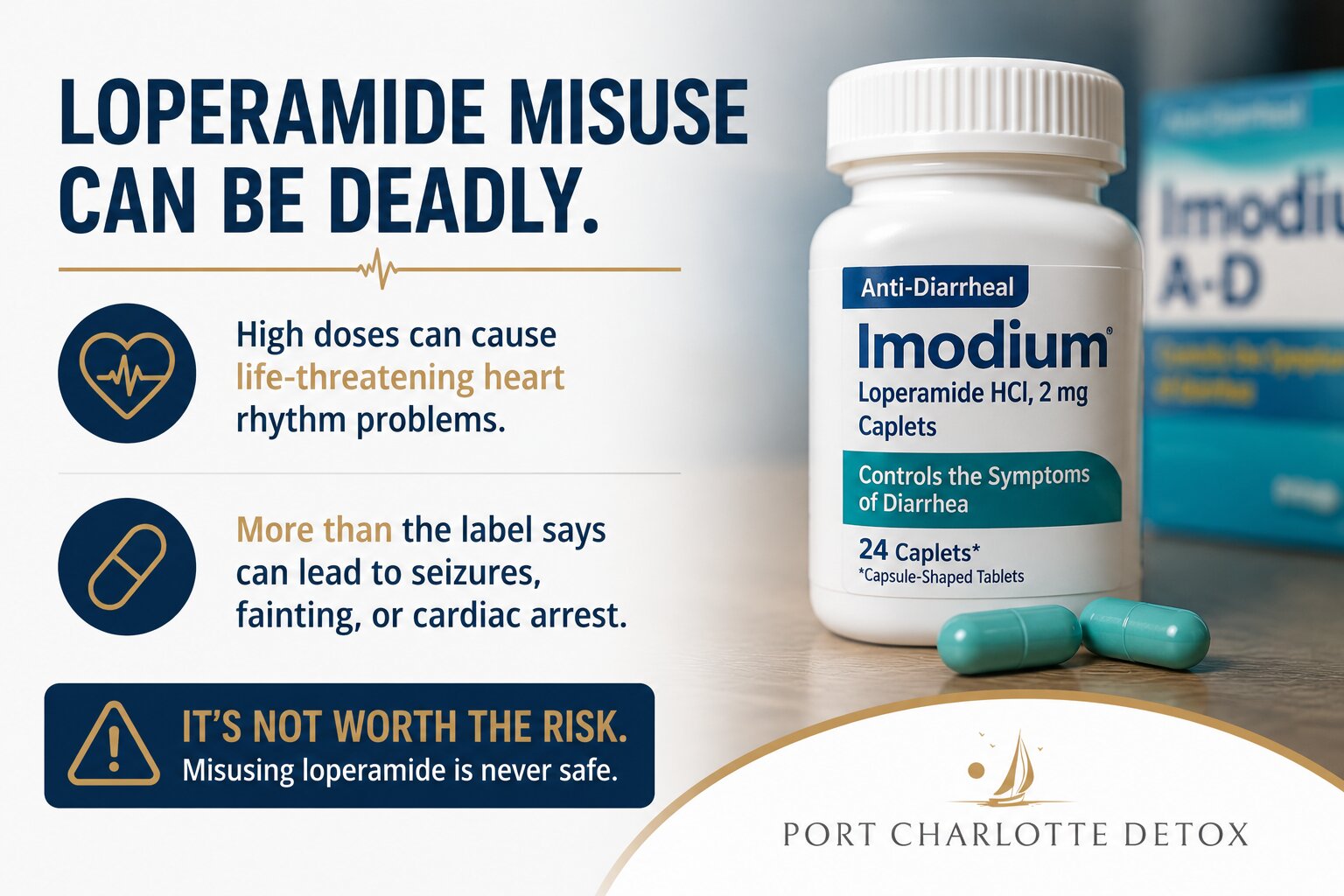
With loperamide, extremely large doses can interfere with the electrical activity of the heart.
The U.S. Food and Drug Administration has warned that misuse may cause serious heart rhythm abnormalities, including:
- QT interval prolongation
- Torsades de Pointes
- Ventricular arrhythmias
- Fainting
- Cardiac arrest
- Sudden death
These complications can occur unexpectedly and may require emergency medical treatment.
Unlike many opioid overdoses, where slowed breathing is the primary concern, high-dose loperamide misuse introduces a significant risk of life-threatening cardiac events.
Other Risks of Loperamide Misuse
Even before heart complications develop, misuse may cause numerous physical and cognitive effects.
Possible side effects include:
- Severe constipation
- Abdominal pain
- Nausea
- Dizziness
- Drowsiness
- Dry mouth
- Difficulty concentrating
Taking extremely large amounts may also increase the likelihood of:
- Confusion
- Loss of consciousness
- Urinary retention
- Electrolyte imbalances
- Drug interactions
Because symptoms can resemble those of other medical emergencies, it is important to seek immediate medical attention if someone becomes unresponsive, develops chest pain, faints, or experiences an irregular heartbeat after taking excessive loperamide.
What Does Loperamide Misuse Say About Opioid Dependence?
Many people feel embarrassed to admit they are using an over-the-counter medication to avoid opioid withdrawal.
In reality, this behavior often signals something important.
If someone is using loperamide to:
- Prevent withdrawal
- Delay opioid use
- Stretch out periods between opioid doses
- Avoid becoming sick after stopping opioids
It usually suggests that physical opioid dependence has developed.
Dependence is not a moral failure.
It is a medical condition in which the brain and body have adapted to regular opioid exposure.
Trying to manage withdrawal alone with over-the-counter medications may delay treatment without addressing the underlying dependence.
Why Medical Supervision Is the Safer Path
Many people try to detox from opioids at home because they worry about judgment or believe they should handle it on their own.
Unfortunately, self-treatment often becomes a cycle of withdrawal, temporary relief, relapse, and increasing frustration.
Medical professionals can help by:
- Monitoring withdrawal symptoms
- Managing discomfort safely
- Identifying medical complications
- Addressing co-occurring health conditions
- Creating a plan for ongoing recovery
Individuals seeking medical detox in southwest Florida receive care designed to improve both safety and comfort during the withdrawal process.
Recovery Is Possible
If you’ve been using loperamide to cope with opioid withdrawal, you are not alone.
Many people resort to over-the-counter medications because they want relief, not because they want to misuse another drug.
The encouraging news is that effective medical treatment exists. Instead of relying on unsafe self-treatment methods, you can receive care that addresses opioid dependence while protecting your health.
Taking that first step can feel overwhelming, but it often leads to a safer, more stable recovery.
Final Thoughts
Although loperamide is sold over the counter, it is not safe to misuse. Taking very large doses in pursuit of a loperamide high or to manage opioid withdrawal can lead to dangerous heart rhythm problems, cardiac arrest, and other serious complications. More importantly, needing loperamide to avoid withdrawal is often a sign that opioid dependence has developed. Port Charlotte Detox proudly provides medically supervised addiction treatment for residents of Charlotte County, Lee County, and Sarasota helping individuals throughout Southwest Florida begin recovery safely.
If you or someone you love is using loperamide to manage opioid withdrawal, that’s a sign opioid dependence has taken hold. Our opioid detox in Port Charlotte team can help you do this safely. Call (844) 336-2690 today or learn more about treatment in Port Charlotte and take the first step toward recovery with confidence.
Frequently Asked Questions
Can Imodium cause a high?
When taken as directed, Imodium does not produce a high. Extremely large doses may cause opioid-like effects in some individuals, but they also carry a significant risk of life-threatening heart complications.
Why is loperamide called “poor man’s methadone”?
Some people use high doses of loperamide in an attempt to reduce opioid withdrawal symptoms. While it may temporarily relieve certain gastrointestinal symptoms, it is not a safe or effective substitute for evidence-based treatment.
Is using loperamide for opioid withdrawal dangerous?
Yes. High-dose loperamide misuse has been linked to serious heart rhythm abnormalities, cardiac arrest, and sudden death. If you are relying on it to manage withdrawal, it is safest to seek medical guidance rather than attempting to detox on your own.