


Maybe you’ve told yourself you’ll stop drinking after the weekend. Or after one more bottle. Or when work slows down.
If you’ve been drinking heavily for months or years, quitting isn’t just a matter of willpower. One of the most serious risks is alcohol withdrawal seizures, which can occur suddenly—even in people who have never had a seizure before.
If you’re thinking about stopping alcohol, knowing what can happen during withdrawal could save your life. Our medical alcohol detox program in Port Charlotte provides around-the-clock monitoring during the highest-risk period so you don’t have to face withdrawal alone.
What Are Alcohol Withdrawal Seizures?
Alcohol withdrawal seizures are generalized tonic-clonic (grand mal) seizures that can occur when someone who has been drinking heavily suddenly stops or dramatically reduces alcohol intake.
Alcohol slows activity in the central nervous system. Over time, the brain adapts by increasing excitatory activity to maintain balance.
When alcohol is suddenly removed, that balance disappears.
Instead of returning to normal immediately, the brain becomes temporarily overactive. In some individuals, this excessive electrical activity can trigger a seizure.
These seizures often happen without warning.
Someone may appear anxious or shaky one moment and lose consciousness the next.
Why the First 48 Hours Matter
Many people assume withdrawal becomes more dangerous several days after the last drink.
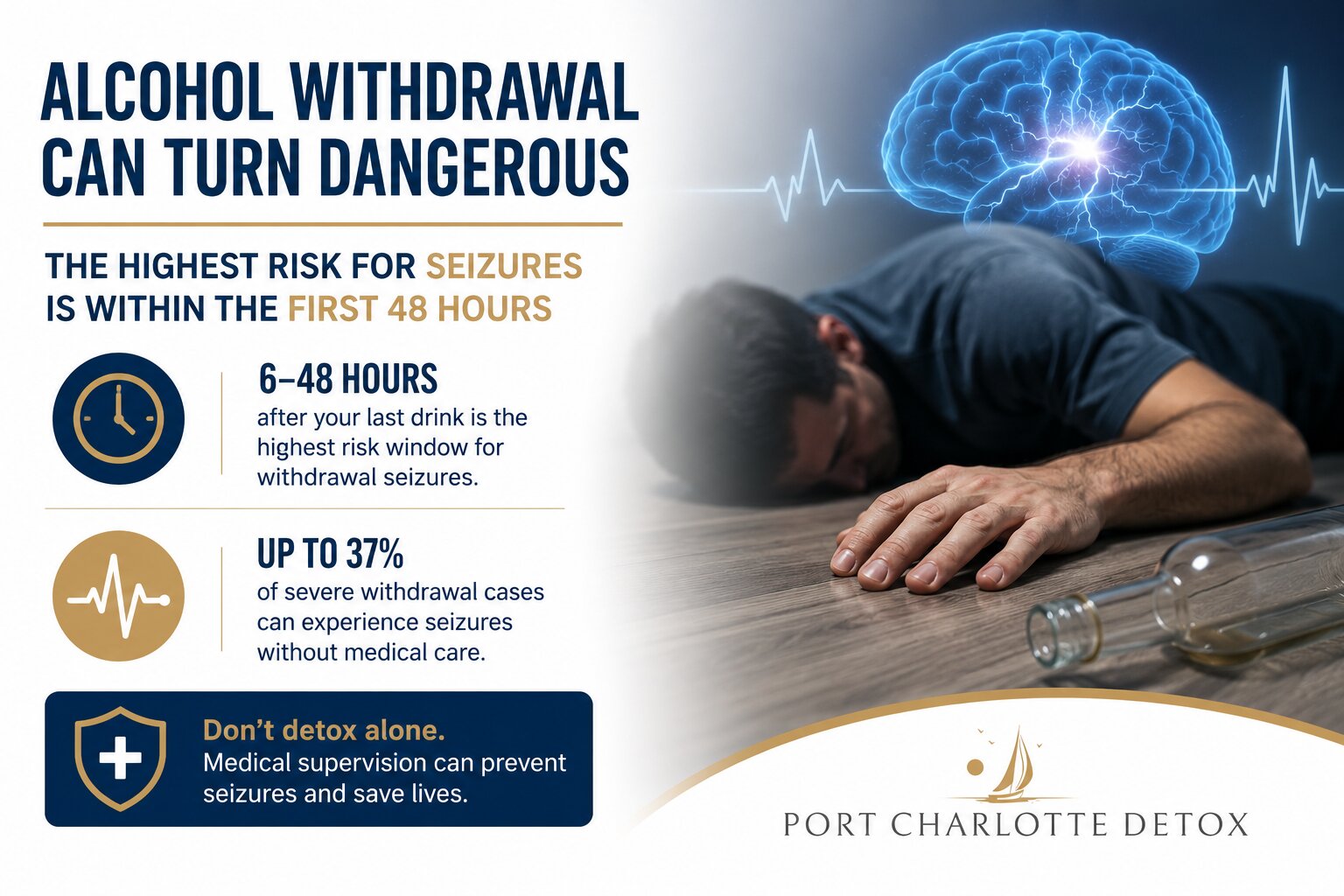
In reality, the highest seizure risk usually occurs much earlier.
The typical timeline looks like this:
6–12 Hours
Early withdrawal symptoms often begin, including:
- Tremors
- Anxiety
- Sweating
- Headache
- Nausea
- Difficulty sleeping
12–48 Hours
This is the period when alcohol withdrawal seizures are most likely to occur.
Not everyone experiences seizures, but this is the critical danger window that requires close observation.
48–72 Hours
Some individuals continue improving, while others may develop delirium tremens (DTs), a severe medical emergency involving confusion, hallucinations, dangerously elevated heart rate, and unstable blood pressure.
Because symptoms can change quickly, feeling “okay” during the first few hours does not mean you are out of danger.
Who Is Most at Risk?
Not everyone who stops drinking experiences seizures.
However, certain factors significantly increase the likelihood.
Risk factors include:
- Heavy daily alcohol use
- Long-term drinking over months or years
- Previous alcohol withdrawal episodes
- A history of withdrawal seizures
- Older age
- Co-occurring medical conditions
- Concurrent use of sedatives such as benzodiazepines
One particularly important concept is the kindling effect.
Each withdrawal episode can make the nervous system more sensitive, increasing the severity of future withdrawals.
Someone whose previous detox involved only shaking and anxiety may develop seizures during a later attempt.
This is one reason repeated home detox attempts become increasingly dangerous.
Why Alcohol Withdrawal Seizures Can Be Fatal
A seizure itself is a medical emergency.
However, the greatest danger often comes from the complications that occur during or after the event.
Potential complications include:
- Head injuries from falls
- Aspiration of vomit into the lungs
- Breathing difficulties
- Status epilepticus, a prolonged seizure requiring emergency treatment
- Cardiac complications
- Death if immediate medical care is unavailable
Even a single seizure should never be ignored.
Emergency evaluation is necessary because seizures can progress rapidly or occur alongside other life-threatening withdrawal complications.
Why Detoxing Alone Is So Dangerous
Many high-functioning professionals convince themselves they can quit quietly at home.
After all, they may still be working, paying bills, and caring for their families.
Unfortunately, alcohol dependence doesn’t measure success by career achievements.
Withdrawal follows biology—not personal determination.
The problem with home detox is that seizures often occur unexpectedly.
There may be:
- No warning
- No one nearby to call emergency services
- No medication available to prevent complications
- No monitoring if symptoms suddenly worsen
Someone who appears stable in the morning can require emergency treatment that evening.
Waiting until symptoms become severe is an unnecessary risk.
How Medical Care Reduces the Risk
Medical professionals cannot erase withdrawal completely, but they can significantly reduce the likelihood of serious complications.
During medically supervised withdrawal, clinicians can:
- Monitor vital signs around the clock
- Administer medications that reduce seizure risk
- Treat dehydration and electrolyte imbalances
- Respond immediately if complications develop
- Adjust treatment based on changing symptoms
For individuals entering medically supervised detox in southwest Florida, continuous observation allows healthcare teams to intervene long before withdrawal becomes life-threatening.
This level of care is especially important during the first two days after the last drink, when seizure risk is at its highest.
Don’t Wait Until Withdrawal Becomes an Emergency
One of the most dangerous misconceptions about alcohol dependence is believing you’ll know if things are becoming serious.
Unfortunately, seizures don’t always provide much warning.
If you:
- Need alcohol to stop shaking
- Wake up needing a drink
- Have experienced withdrawal before
- Drink heavily every day
- Have ever had a withdrawal seizure
you should speak with a medical professional before trying to quit on your own.
Planning ahead is far safer than reacting to an emergency.
Recovery Starts With a Safer First Step
Many people avoid treatment because they worry about taking time away from work or family.
Ironically, an emergency hospitalization caused by withdrawal is far more disruptive than planning a medically supervised withdrawal.
Seeking help is not admitting defeat.
It’s recognizing that alcohol has changed how your brain functions and that your body deserves medical care during the recovery process.
The goal is not simply getting through withdrawal.
It is getting through it safely so you can begin long-term recovery with the strongest possible foundation.
Final Thoughts
Alcohol withdrawal seizures are one of the most dangerous complications of stopping alcohol suddenly. They most often occur within the first 6 to 48 hours after the last drink and can lead to life-threatening injuries, breathing problems, or prolonged seizures without immediate medical care. If you’ve been drinking heavily, trying to detox alone is a risk that simply isn’t worth taking.
Alcohol withdrawal seizures are preventable with proper medical care. Our medical alcohol detox in Port Charlotte team monitors you through every hour of the danger window. Call (844) 336-2690 today or learn more about treatment in Port Charlotte and take the first step toward recovery with confidence. Port Charlotte Detox proudly provides medically supervised addiction treatment for residents of Charlotte County, Lee County, and Sarasota helping individuals throughout Southwest Florida begin recovery safely.
Frequently Asked Questions
When do alcohol withdrawal seizures usually happen?
Most alcohol withdrawal seizures occur between 6 and 48 hours after the last drink, making the first two days the highest-risk period.
Can someone have a seizure even if they’ve never had one before?
Yes. Alcohol withdrawal seizures can occur in people with no previous history of epilepsy or seizures, particularly after prolonged heavy drinking.
Should I go to the emergency room if someone has an alcohol withdrawal seizure?
Yes. A seizure during alcohol withdrawal is a medical emergency. Call emergency services immediately, as the person may require medications, monitoring, and treatment for potentially life-threatening complications.