


You haven’t lost your job.
You answer texts.
You show up for people.
From the outside, your life may look completely intact.
But functioning and feeling okay are not always the same thing.
A lot of people searching late at night for answers about insurance and medical detox are not the stereotype they’ve carried in their heads for years. They’re parents, nurses, contractors, teachers, business owners, retirees, and professionals who quietly built their lives around alcohol without fully realizing how much energy it was taking to maintain the illusion of control.
The question “Do they take insurance?” is often tied to another question people are almost afraid to say out loud:
“Can I actually get help without destroying the life I worked so hard to hold together?”
The answer is often yes.
Many people seeking alcohol addiction treatment in Florida are still functioning at a high level. They’re not looking for drama. They’re looking for relief. They want their body to stop feeling dependent. They want their mind to quiet down. They want to stop planning their day around drinking without feeling judged for needing help.
And for many people, verifying insurance benefits becomes the first small step toward breathing again.
High-Functioning Doesn’t Mean Healthy
One of the hardest things about alcohol dependence is how easy it can be to hide — especially from yourself.
You may still be:
- Paying your bills
- Going to work every day
- Taking care of your family
- Socializing normally
- Keeping up appearances online
That doesn’t mean alcohol isn’t affecting your body, your nervous system, or your emotional life.
Many high-functioning people normalize symptoms for years because there’s no dramatic “rock bottom.” Life just slowly becomes harder to manage.
You may notice:
- Waking up anxious at 3am
- Feeling shaky until your first drink
- Drinking more than you planned almost every night
- Irritability that seems to come out of nowhere
- Trouble concentrating during meetings
- Needing alcohol to relax, sleep, socialize, or feel “normal”
Some people describe it as carrying a second full-time job nobody else can see.
One patient once told me:
“I spent more energy hiding my drinking than I spent actually living my life.”
That kind of exhaustion catches up eventually.
Why So Many People Delay Medical Detox
Most people don’t wait because they don’t care.
They wait because they’re scared.
High-functioning adults often delay treatment for very specific reasons:
- Fear of being judged
- Fear of losing privacy
- Fear work will find out
- Fear they’re “not bad enough”
- Fear treatment means giving up their identity
- Fear of withdrawal symptoms
- Fear of failing after asking for help
The irony is that many people who finally enter treatment say the anticipation was worse than the experience itself.
Medical detox is not about punishment or humiliation. It’s about helping your body stabilize safely while reducing the risks associated with alcohol withdrawal.
For some people, withdrawal can become medically dangerous without supervision. Symptoms may include:
- Severe anxiety
- Tremors
- Elevated heart rate
- Nausea and vomiting
- Sweating
- Insomnia
- Hallucinations
- Seizures in serious cases
This is why medically supervised support matters. Alcohol withdrawal is not something people should try to “tough out” alone simply because they’re used to functioning through discomfort.
Insurance Questions Are More Common Than You Think
A surprising number of people quietly search the exact same thing:
“Does medical detox for alcohol take insurance?”
They ask because treatment feels financially overwhelming before they understand their options.
Many insurance providers may help cover portions of:
- Medical detox
- Assessments
- Medication management
- Ongoing treatment recommendations
- Behavioral health services
Coverage depends on several factors, including:
- Your insurance provider
- Deductibles
- Network status
- Medical necessity
- Recommended level of care
For many people exploring alcohol detox Port Charlotte treatment options, insurance verification becomes a way to gather information without committing to anything immediately.
That matters emotionally.
When someone feels trapped, information creates breathing room.
You do not have to decide your entire future in one phone call. Sometimes the first conversation is simply about understanding what’s available to you.
The Quiet Cost of “Keeping It Together”
High-functioning alcohol dependence often comes with a strange loneliness.
Because your life appears stable, people may not realize how much effort it takes to maintain it.
You may become the person everyone depends on while privately feeling like you’re unraveling.
That disconnect can create enormous shame.
A lot of people tell themselves:
- “I should be able to handle this.”
- “Other people have it worse.”
- “I’m still functioning.”
- “I can stop anytime.”
- “I just need to cut back.”
But there’s a difference between functioning and living well.
Sometimes people aren’t even drinking to feel good anymore. They’re drinking to avoid discomfort:
- To stop the anxiety
- To quiet racing thoughts
- To sleep
- To feel less emotionally flat
- To avoid withdrawal symptoms
- To make it through social situations
Over time, alcohol stops feeling like a reward and starts feeling like maintenance.
That shift can happen gradually enough that people barely notice until they’re deeply tired.
What Medical Detox Actually Feels Like for Many People
There’s often a misconception that detox is cold, harsh, or humiliating.
For many people, the experience is surprisingly human.
The first thing some patients feel is relief. Not because everything is fixed overnight, but because they finally stop carrying the secret alone.
A medically supervised setting may include:
- Monitoring withdrawal symptoms
- Medication support when appropriate
- Medical oversight
- Emotional support
- Help transitioning into next-step care if needed
For someone who’s been silently managing anxiety, insomnia, and dependence for years, simply feeling physically safe can be emotional.
One executive described it this way:
“It was the first time in years I didn’t have to pretend I was okay.”
That sentence stays with me because it captures something many high-functioning people don’t realize until they slow down: constant self-management is exhausting.
Recovery Doesn’t Always Look Dramatic
Social media tends to show dramatic before-and-after stories.
Real recovery is often quieter.
It’s someone sleeping through the night without waking up panicked.
It’s eating dinner without needing alcohol to “take the edge off.”
It’s showing up emotionally instead of mechanically.
It’s laughing without forcing it.
Sometimes recovery starts with very ordinary moments:
- Drinking coffee without shaking
- Remembering conversations clearly
- Feeling less emotionally numb
- Having energy again
- Being present with family
- Going a full day without obsessing over alcohol
These shifts matter.
And contrary to what many people fear, getting help does not erase your personality, intelligence, creativity, or ambition.
Many people discover they were never losing their edge by stopping alcohol. They were losing themselves trying to sustain the exhaustion of dependence.
You Don’t Have to Wait Until Everything Falls Apart
One of the most damaging myths about alcohol treatment is that you need a catastrophic collapse before you deserve support.
You don’t.
You do not have to:
- Lose your career
- Get arrested
- End a marriage
- Hit a public rock bottom
- Completely fall apart
before asking questions about treatment.
In fact, many people who seek help earlier often have more emotional and practical stability to build from.
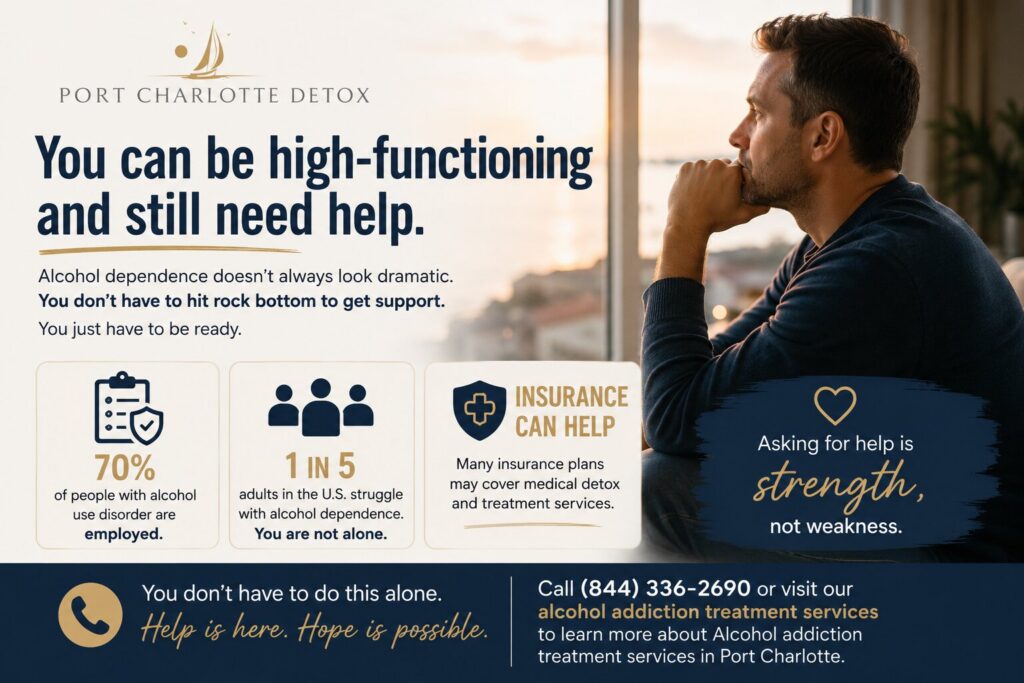
Reaching out for information about alcohol detox Port Charlotte care options doesn’t mean you’re weak. It means part of you is tired of carrying this alone.
That part deserves attention.
FAQ: Medical Detox and Insurance for Alcohol Use
Does insurance usually cover alcohol detox?
Many insurance plans may cover some or all of medically supervised alcohol detox depending on your provider, deductible, and medical necessity. Coverage varies, which is why benefit verification is often the first step.
Can I go to detox if I still have a job and responsibilities?
Yes. Many people entering treatment are employed, raising families, or managing professional responsibilities. High-functioning alcohol dependence is extremely common.
Is alcohol withdrawal dangerous?
It can be. Some withdrawal symptoms become medically serious without supervision, including seizures and severe complications. Medical oversight helps improve safety during withdrawal.
Will my employer know if I seek treatment?
Privacy laws protect medical information in most situations. Many people are surprised to learn how confidential treatment conversations actually are.
How long does medical detox usually last?
The timeline varies depending on drinking history, physical health, withdrawal symptoms, and individual needs. For many people, detox lasts several days before recommendations for ongoing care are discussed.
What if I’m not sure I “really” need treatment?
That uncertainty is incredibly common, especially among high-functioning adults. Many people begin by simply asking questions or verifying insurance benefits before making any decisions.
Can I detox at home instead?
Because alcohol withdrawal can become medically risky, detoxing alone is not always safe. A medical evaluation can help determine the safest option for your situation.
What happens after detox?
Detox is often the beginning, not the entire process. Some people continue with additional support, therapy, structured daytime care, or recovery planning depending on their needs and goals.
There’s no perfect time to ask for help. Most people wait until they’re emotionally exhausted, physically depleted, or quietly scared by how dependent they’ve become.
You don’t have to earn support by suffering longer.
Call (844)336-2690 or visit our compassionate alcohol addiction treatment services to learn more about Alcohol addiction treatment services in Port Charlotte.