


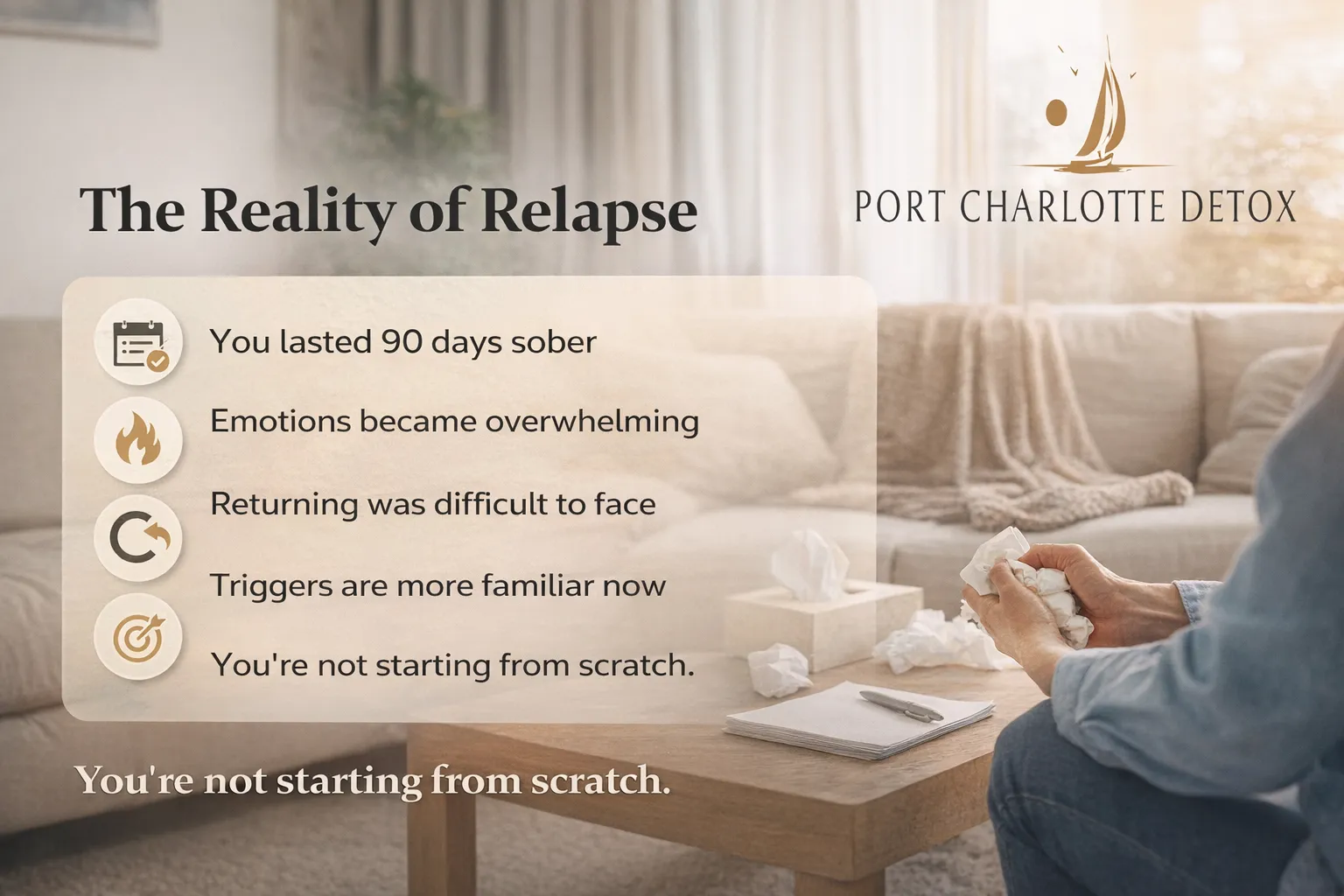
You don’t forget what it felt like to have 90 days.
That kind of time changes you. Even if you didn’t say it out loud, part of you started to believe, “Maybe I really can do this.”
So when things slip… it doesn’t just feel like a setback.
It feels personal.
Like you lost something you already proved you could hold onto.
If you’re here, thinking about trying again—even quietly—there’s something you need to hear from someone who understands it from the inside:
This isn’t starting over the way you think it is.
And it doesn’t have to carry the same weight this time.
If anything, this time has the potential to be more honest than the first—especially if you’re considering options like getting support again.
The Kind of Shame That Only Comes After Progress
The first time, the feeling is fear.
The second time, it’s heavier than that.
Because now you know what it’s like to feel better—and losing that hits differently.
It’s not just about drinking again.
It’s about the voice in your head that says:
“You had it. And you couldn’t keep it.”
That voice can get loud.
But here’s the truth it leaves out:
You didn’t lose everything. You didn’t erase your progress. You didn’t undo the person you became during those 90 days.
You just ran into something you weren’t fully equipped to handle yet.
That’s not failure. That’s information.
You’re Not Back at the Beginning—Even If It Feels That Way
Relapse has a way of convincing you that you’re starting from zero.
But you’re not the same person who walked in the first time.
You already know:
- What early clarity feels like
- What your triggers look like in real life
- Where things started to slip, even if it was subtle
That matters.
Because now you’re not walking in blind. You’re walking in aware.
And awareness changes everything—even if it doesn’t feel like it yet.
The Second Time Around Is Less About Image
The first time, a lot of us are still holding onto something.
Control. Pride. The idea that we’ll “handle it” and move on.
There’s often a quiet pressure to do it right. To succeed. To prove something.
But the second time?
That layer starts to peel back.
Because now you’ve felt what it’s like to lose momentum. You’ve seen how quickly things can shift.
So the focus changes.
It’s less about looking okay—and more about actually being okay.
And that’s where honesty begins to take the lead.
You Start Seeing What You Missed the First Time
Not because you failed—but because you weren’t ready to see it yet.
That might look like:
- Avoiding certain emotions that felt too heavy
- Going back to the same environment too quickly
- Thinking structure alone would carry you long-term
- Underestimating how important ongoing support would be
These aren’t mistakes in the way you think.
They’re gaps.
And now you can see them more clearly—which means you can actually do something about them.
This Time, You’re Not Guessing as Much
The first time can feel like walking into something unfamiliar.
You’re learning as you go. Trying to understand what works.
The second time feels different.
You already know certain things:
- What helps you feel grounded
- What doesn’t work for you
- Where your mindset starts to shift
That doesn’t make it easy.
But it makes it more intentional.
You’re not guessing—you’re adjusting.
The Fear of Judgment Is Real—but It’s Not What You Think
One of the hardest parts about coming back is the fear of being seen.
Like people will look at you differently. Like your effort the first time didn’t count.
But here’s what actually happens more often than not:
People don’t see failure.
They see honesty.
They see someone who didn’t disappear. Someone who came back instead of pretending everything was fine.
And that takes more strength than most people give it credit for.
For individuals navigating this in Charlotte County, Florida, that moment—choosing to come back instead of staying stuck in silence—often becomes the real turning point.
It’s Not About Proving You Can Do It Again
That mindset will wear you out fast.
“I need to get back to where I was.”
“I need to do it better this time.”
“I can’t mess this up again.”
That pressure builds quickly.
And pressure rarely creates stability.
This time, it’s less about proving—and more about understanding.
What actually supports you?
What makes things sustainable?
What needs to change—not just short-term, but long-term?
Those questions matter more than performance.
You’re Allowed to Slow This Down
The first time, there’s often urgency.
Fix it. Get through it. Move on.
The second time invites something different.
Slowness.
Not dragging your feet—but actually giving yourself space to process what’s happening instead of rushing past it.
For many people reconnecting with care in Lee County, Florida, this shift—from urgency to intentional pace—becomes one of the biggest differences in how things unfold.
You’re not behind.
You’re recalibrating.
The Truth About Relapse That No One Likes to Say
Relapse doesn’t mean you didn’t want it badly enough.
It usually means something underneath the surface needed more attention than it got.
Something unresolved. Something avoided. Something you didn’t have the tools for yet.
That’s not a flaw.
That’s a signal.
And signals are meant to be understood—not ignored or judged.
What Feels Different This Time (Even If You Can’t Explain It Yet)
There’s often a quieter awareness.
Less noise. Less denial. Less pretending.
You might not feel confident—but you feel clearer.
And clarity, even when it’s uncomfortable, is a powerful place to start from.
Because now you’re not just trying to stop.
You’re trying to understand.
And that’s where real change takes root.
FAQs
Is relapse after 90 days common?
More common than people talk about.
That stretch of time is long enough to build confidence—but sometimes not long enough to fully stabilize deeper patterns. Relapse doesn’t erase progress. It reveals where more support might be needed.
Why does it feel worse the second time?
Because you’ve experienced what it’s like to feel better—and losing that contrast hits harder emotionally.
It’s not just about starting again. It’s about grieving what you had.
Does going back mean I failed?
No.
It means you’re choosing to re-engage instead of giving up. That’s not failure—that’s persistence, even if it doesn’t feel like it yet.
What should I do differently this time?
Less focus on proving. More focus on understanding.
Pay attention to what led up to the relapse, not just the relapse itself. That’s where the real insight is.
What if I’m embarrassed to come back?
That feeling is normal.
But most people aren’t judging you the way you think. They understand this process better than you assume—and they respect the fact that you’re showing up again.
Can things actually feel better the second time?
Yes.
Not easier—but often more real.
Less performance. More honesty. And that shift can make the work more meaningful—and more sustainable.
A Final Thought to Sit With
The first time, you proved something to yourself.
The second time, you understand something about yourself.
And those are two very different kinds of growth.
If you’re here—even considering trying again—that part of you hasn’t given up.
It’s still paying attention. Still willing to try. Still looking for a way forward.
That matters more than the relapse ever could.
Call (844)336-2690 to learn more about our alcohol detox in Florida.