


You’ve probably had this conversation with yourself more than once.
“I’ll just stop. I’ll deal with it. It might be rough, but I can handle it.”
And maybe part of you believes that. You’ve pushed through hard things before.
But this is different in a way that isn’t always obvious at first.
Quitting drinking isn’t just a decision—it’s a physical shift, an emotional shift, and a mental reset happening all at once. And trying to manage all three alone can feel heavier than expected.
If you’ve been weighing whether to do this on your own or look into something like safe withdrawal support, it helps to understand what’s actually at stake.
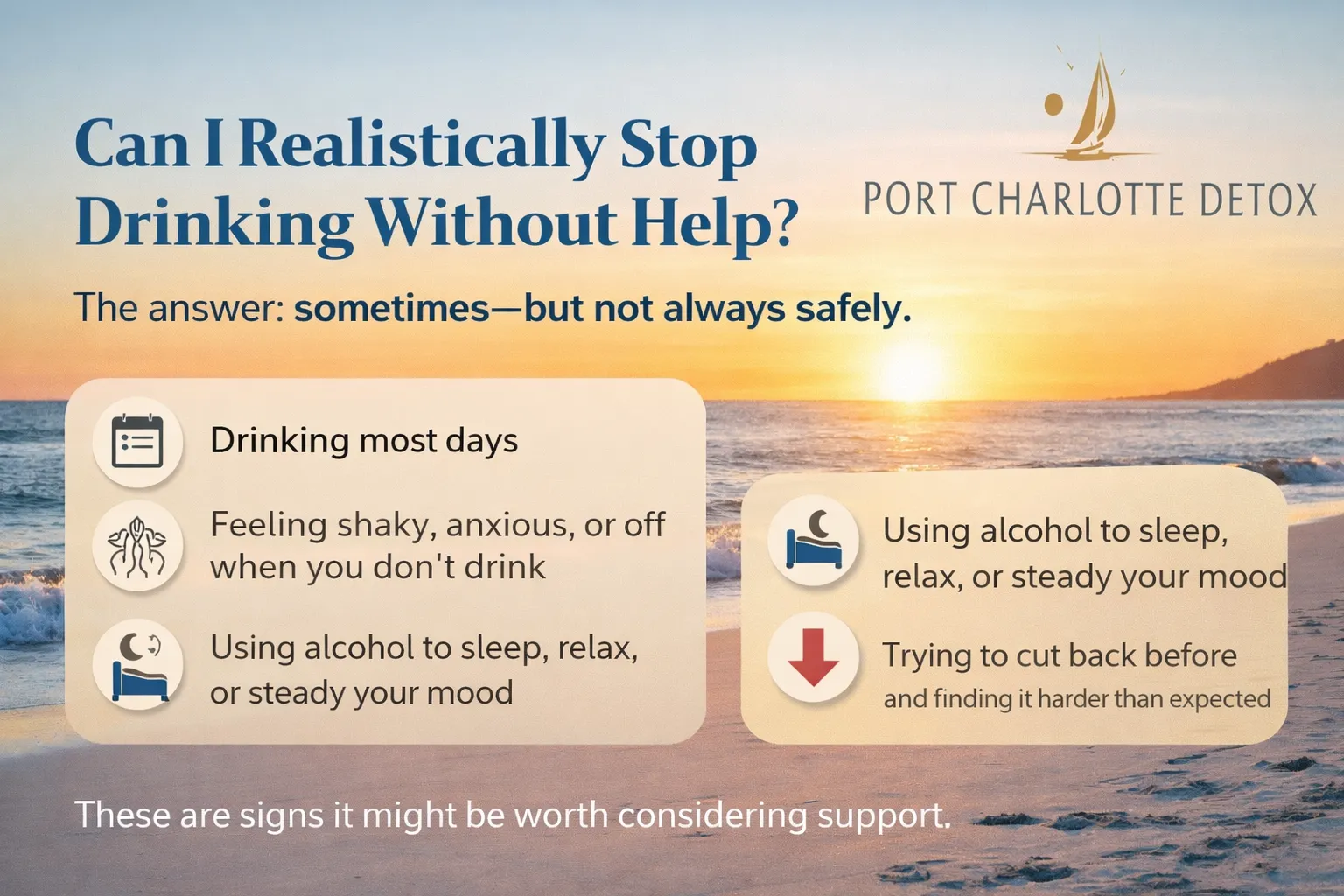
Can I realistically stop drinking without help?
The honest answer is: sometimes—but not always safely.
A lot of people assume quitting is about discipline. Just deciding and following through.
But your body may have adapted to alcohol in ways that don’t show up until you stop.
That’s where things can feel confusing.
You might expect discomfort. What surprises people is how quickly that discomfort can shift into something harder to manage alone.
This isn’t about whether you’re strong enough. It’s about whether your body needs support through the change.
What are the signs I shouldn’t do this alone?
This part doesn’t require overthinking. It just requires honesty.
If any of these feel familiar, it’s worth pausing before going solo:
- Drinking most days, even if it feels routine
- Feeling shaky, anxious, or off when you don’t drink
- Using alcohol to sleep, relax, or steady your mood
- Trying to cut back before and finding it harder than expected
What people often miss is that risk doesn’t always look extreme.
Sometimes it starts quietly—and builds.
What does it actually feel like when you stop?
This is where expectations and reality tend to split.
Most people expect it to be uncomfortable but manageable.
Sometimes it is.
Other times, it feels like your body is trying to recalibrate faster than it knows how.
You might notice restlessness that doesn’t settle. Sleep that disappears. Anxiety that feels sharper than usual. Physical tension that shows up out of nowhere.
And in some cases, symptoms can escalate in ways that feel overwhelming.
That’s not failure. That’s your body asking for help.
Why do people still try to push through alone?
Because it feels easier at first.
No explaining yourself. No stepping into something unfamiliar. No admitting out loud that this might be bigger than you thought.
There’s also pride in it.
A quiet voice that says, “I should be able to do this on my own.”
But here’s the shift that matters:
If your body is struggling, pushing harder doesn’t prove strength—it creates more resistance.
And resistance doesn’t lead to lasting change. Support does.
Is getting help too much for where I’m at?
This question keeps a lot of people stuck.
“I’m not that bad.”
“I don’t need that level of help.”
“I should try on my own first.”
But here’s what often happens next:
People try alone. It feels harder than expected. They get discouraged. And then they wait even longer before trying again.
You don’t have to earn support by making things worse first.
For many people exploring options in Charlotte County, Florida, the turning point isn’t hitting a crisis—it’s realizing they don’t want to keep guessing their way through something this important.
What actually changes when you have support?
Clarity replaces uncertainty.
Instead of wondering what’s happening in your body, you understand it.
Instead of white-knuckling through discomfort, you have ways to manage it.
Instead of sitting alone with your thoughts, you have someone guiding you through them.
And maybe most importantly—you don’t have to constantly ask yourself, “Am I okay right now?”
You just focus on the next step.
For individuals considering care in Lee County, Florida, this often becomes the biggest difference: not doing it alone doesn’t make you dependent—it makes the process more stable.
What if I start and can’t follow through?
That fear is real—and more common than people admit.
“What if I try and it doesn’t work?”
But starting isn’t about guaranteeing success.
It’s about giving yourself a different experience than the one you’ve been stuck in.
And if things get hard, support means you don’t have to carry that moment alone.
You don’t fall as far. You don’t feel as stuck.
You adjust—and keep going.
What does the first step actually look like?
It’s not signing your life away.
It’s not committing to forever.
It’s a conversation.
A real one.
Not the version where you minimize or round things down—but the honest version of what your drinking actually looks like.
From there, you get clarity.
And clarity makes decisions feel less overwhelming.
The part most people don’t say out loud
You don’t need a dramatic story to deserve change.
You don’t need to prove that things are “bad enough.”
Sometimes the hardest part isn’t quitting.
It’s giving yourself permission to want something different.
To feel better. To sleep better. To not have your day revolve around something that used to feel optional.
That quiet voice in your head—the one that’s asking if there’s another way—that voice matters.
A final thought to sit with
Trying to quit drinking alone can feel like standing in the middle of a storm, telling yourself to just stay upright no matter how strong the wind gets.
Support doesn’t take away your effort.
It gives you something steady to stand on while you make the change.
If part of you is already wondering whether you should approach this differently this time, that’s not doubt—that’s awareness.
And awareness is where real change begins.
Call (844)336-2690 to learn more about our alcohol detox in Florida.