


You might not call yourself an alcoholic.
You might still go to work. Show up for your family. Pay your bills.
But something feels… off.
Maybe you’ve wondered what it would feel like to wake up without regret. Or to go a week without thinking about when you’ll drink next. Maybe you’ve hovered over pages like our alcohol recovery support late at night—curious, but not desperate.
If that’s you, hear this clearly:
You do not have to decide you’re quitting forever in order to try getting help.
You just have to be willing to explore.
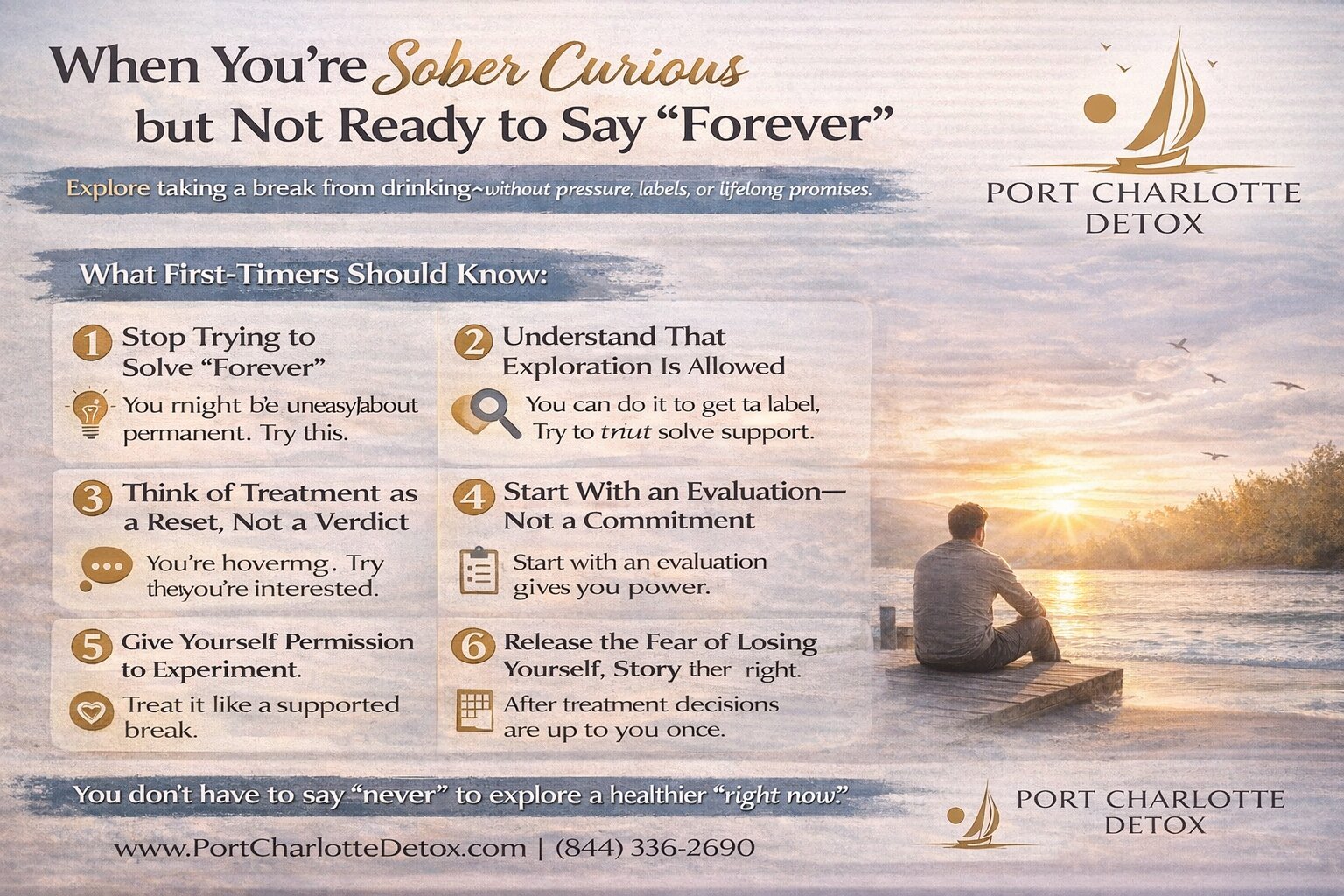
1. Stop Trying to Solve “Forever”
“Am I ready to quit forever?”
That question stops more people than drinking ever did.
It’s too big. Too permanent. Too identity-shifting.
Instead, try this:
- Am I willing to take a break?
- Am I open to seeing how I feel without alcohol?
- Am I curious enough to learn more?
Treatment is not a lifetime contract. It’s not a vow. It’s not a tattoo on your identity.
It’s information.
And information gives you power.
You don’t need to predict who you’ll be in five years. You just need to decide what you want your next month to feel like.
2. Understand That Exploration Is Allowed
One of the biggest myths we see is this:
“If I walk into treatment, I’m admitting I’m an addict forever.”
That fear keeps people stuck.
The truth? Many people enter alcohol addiction treatment not because they’re certain — but because they’re uncertain.
They’re tired.
They’re questioning.
They’re noticing patterns they don’t like.
Curiosity is enough.
You don’t have to wear a label to deserve support. You don’t have to lose everything to justify asking for help.
You can simply say:
“I want to understand my relationship with alcohol better.”
That’s a strong place to begin.
3. Think of Treatment as a Reset, Not a Verdict
Imagine your life is a treadmill that’s been running just a little too fast for a little too long.
Alcohol might be how you keep up. Or how you numb out after. Or both.
Trying to figure out whether you’ll drink for the rest of your life while you’re still on that treadmill? Nearly impossible.
Stepping off — even briefly — changes everything.
A short-term stay or structured support gives your brain time to settle. Your nervous system resets. Your sleep improves. Your anxiety levels out.
And when that fog lifts, your decisions become clearer.
One former client told us:
“I thought I was signing up to be labeled forever. Instead, I finally felt like myself again.”
That clarity is what you’re actually seeking.
Not a label.
4. Ask Questions That Actually Matter
Instead of “Am I an alcoholic?” try asking:
- Do I feel uneasy about how much I drink?
- Have I tried to cut back and found it harder than I expected?
- Is alcohol solving my stress — or quietly adding to it?
- Do I feel better physically when I take breaks?
- Am I tired of thinking about it?
Those questions are more useful than any identity debate.
You don’t need a dramatic rock bottom. Sometimes the quiet realization is more powerful:
“I’m functioning… but I’m not thriving.”
That matters.
5. Start With an Evaluation — Not a Commitment
You are allowed to gather information before making decisions.
At Port Charlotte Detox, that often begins with a confidential assessment. Not pressure. Not contracts. Just a conversation.
We talk about:
- Your drinking patterns
- Physical symptoms
- Sleep and mood changes
- Stress levels
- What you want (even if you’re unsure)
From there, we outline options. Maybe that includes a short stay for medical support. Maybe it’s a structured daytime program. Maybe it’s simply education and next steps.
You stay in control.
The goal isn’t to trap you into lifelong sobriety.
The goal is to help you make a clear decision — not one made in exhaustion or shame.
6. Let Your Body Help You Decide
Here’s something many sober curious people don’t realize:
Your brain on alcohol is not neutral.
It’s chemically influenced. Anxiety, cravings, irritability — they’re not just personality traits. They’re often withdrawal cycles.
When you step away from drinking with proper support:
- Sleep stabilizes
- Blood pressure improves
- Mood evens out
- Focus sharpens
- Anxiety often decreases
You may discover that the “edge” you thought alcohol helped with was actually being created by alcohol itself.
And when your system stabilizes, your decision about the future becomes less emotional and more informed.
That’s autonomy.
7. Give Yourself Permission to Experiment
You’re allowed to treat this like a trial period.
Not of sobriety forever.
Of clarity.
Think of it like this:
If alcohol truly adds value to your life, taking a supported break shouldn’t threaten you.
But if the idea of stopping — even temporarily — creates fear or panic? That’s useful information.
Experimentation isn’t weakness. It’s self-awareness.
8. Release the Fear of Losing Yourself
Some sober curious individuals worry:
“What if I get boring?”
“What if I lose my edge?”
“What if I don’t fit in anymore?”
That fear is real. We won’t dismiss it.
But here’s what we see time and time again:
When people stabilize, they don’t lose themselves.
They rediscover parts that alcohol was quietly covering up.
Creativity returns.
Confidence becomes less performative.
Social connection feels more grounded.
You don’t become smaller.
You become steadier.
9. You Can Change Your Mind Later
This is important.
Trying treatment does not legally bind you to sobriety.
You can decide afterward that you want long-term recovery.
You can decide to continue structured care.
You can decide you need more support.
Or you can decide differently.
The difference is that your choice will be made from clarity — not from craving, not from shame, not from exhaustion.
And that’s the whole point.
Frequently Asked Questions
Do I have to call myself an alcoholic to start treatment?
No. Labels are not a requirement. Many people enter support simply because they’re questioning their relationship with alcohol or feeling physically or emotionally affected by it.
What if I’m not “bad enough” for treatment?
If you’re wondering whether your drinking is affecting you, that’s enough reason to explore. You don’t have to wait for consequences to pile up. Early support is often easier and less disruptive than waiting for a crisis.
Will I be pressured to stay sober forever?
No. Our role is to help you stabilize, educate you, and support informed decisions. Long-term sobriety is a personal choice — not something forced on you.
How long do I have to stay?
Length of stay depends on your needs and goals. Some people start with short-term medical support. Others continue into structured care. It’s a collaborative process.
What if I change my mind?
You’re allowed to. Exploration is not failure. Many people learn valuable things about themselves even if their path evolves.
Is it confidential?
Yes. Your assessment and participation are confidential. Many of our clients are professionals, parents, and community members who value privacy.
What if I’m scared?
That’s normal. Most people are nervous before reaching out. Fear doesn’t mean you shouldn’t explore. It usually means something important is shifting.
You don’t need to hit bottom.
You don’t need to declare forever.
You don’t need to adopt a label that doesn’t fit.
You just need to be honest about how you’re feeling right now.
If you’re sober curious and quietly searching for clarity, we’re here to help you explore without pressure. Our approach to alcohol addiction treatment is designed to stabilize you, inform you, and support whatever healthy decision comes next. Serving Charlotte County, FL & Lee County, FL.
Call (844)336-2690 or visit our Alcohol addiction treatment services in to learn more about our Alcohol addiction treatment services in Port Charlotte, Florida.