


If you’ve been wondering how long does Ativan stay in your system, you’re probably looking for answers for a reason. Maybe you’re preparing for a drug test, thinking about stopping the medication, or worried about withdrawal after taking it regularly. Whatever brought you here, you’re not alone—and it’s normal to have questions.
Understanding how long Ativan remains in the body can help you make informed decisions, but it’s equally important to understand that leaving your system isn’t the same as leaving your brain. If you’ve been taking Ativan regularly, learning about benzodiazepine detox can help you understand why medical supervision is often the safest way to stop.
What Is Ativan?
Ativan is the brand name for lorazepam, a prescription benzodiazepine commonly used to treat:
- Anxiety disorders
- Panic attacks
- Short-term insomnia related to anxiety
- Seizures
- Sedation before certain medical procedures
It works by enhancing the effects of gamma-aminobutyric acid (GABA), a neurotransmitter that slows activity in the brain. This calming effect can relieve anxiety and muscle tension, but with regular use, the brain can become dependent on the medication.
Understanding Ativan’s Half-Life
One of the biggest factors that determines how long does Ativan stay in your system is its half-life.
A drug’s half-life is the amount of time it takes for approximately half of the medication to leave the bloodstream.
For Ativan:
- Average half-life: 10 to 20 hours
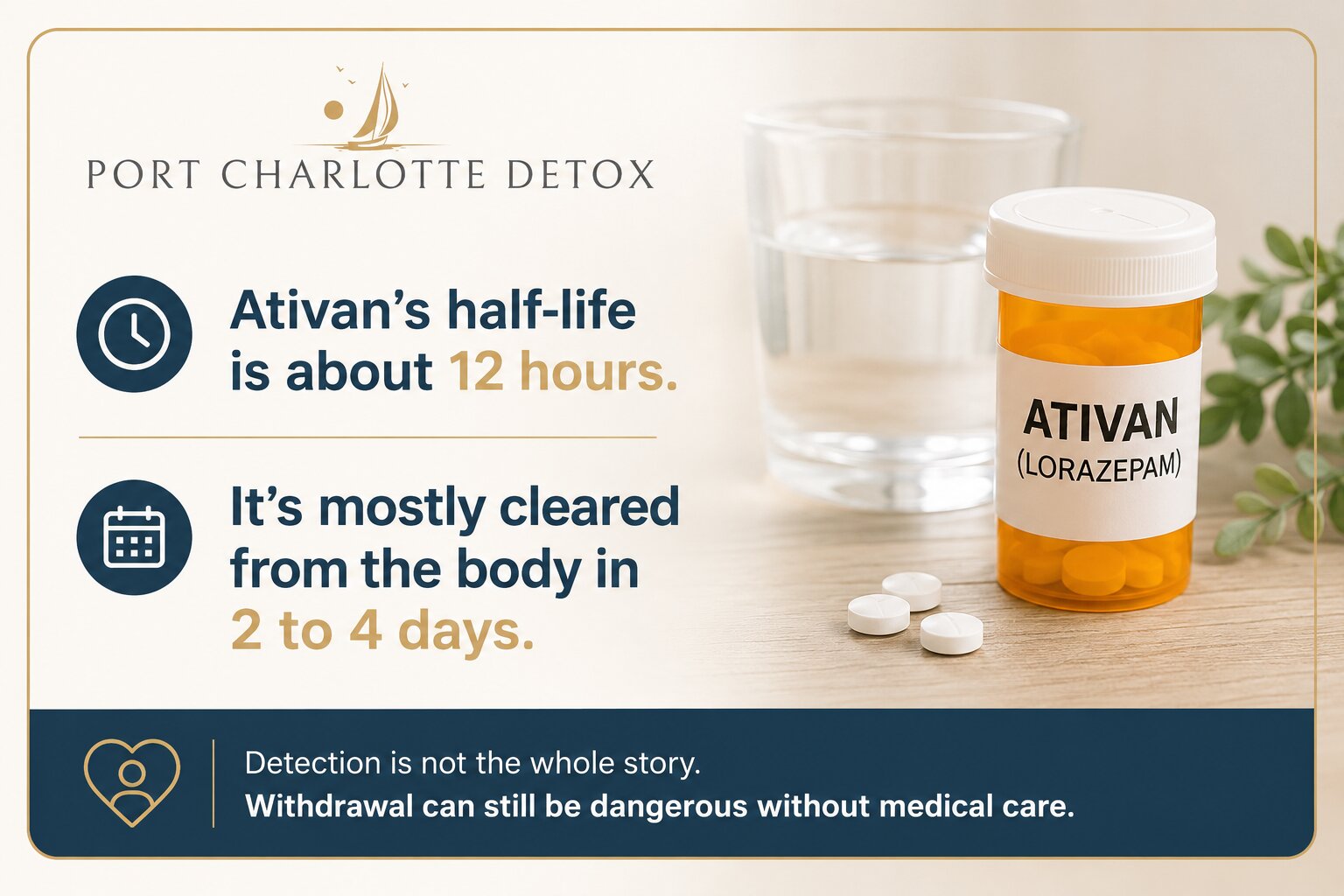
- Typical average: About 12 hours
Most medications require about five half-lives to be largely eliminated from the body. For many people, this means Ativan is mostly cleared within 2 to 4 days, although small amounts may remain detectable longer depending on the type of drug test used.
How Long Is Ativan Detectable?
Even after the medication’s effects wear off, it may still be detected in laboratory testing.
| Test Type | Approximate Detection Window |
|---|---|
| Blood | Up to 3 days |
| Urine | About 5–6 days (sometimes longer with regular use) |
| Saliva | Up to 2–3 days |
| Hair | Up to 90 days |
These windows are estimates rather than guarantees. Detection varies from one person to another.
It’s also important to remember that a positive drug test does not necessarily indicate current impairment—it simply means the medication or its metabolites remain detectable.
What Affects How Quickly Ativan Leaves the Body?
No two people process Ativan at exactly the same rate.
Several factors influence clearance, including:
Dose
Higher doses generally remain in the body longer because there is more medication to metabolize.
Frequency of Use
Someone taking Ativan occasionally may clear it faster than someone who has taken it daily for months.
Age
Older adults often metabolize medications more slowly, extending detection times.
Metabolism
People naturally process medications at different rates based on genetics and overall health.
Liver Function
Although lorazepam relies less heavily on liver metabolism than some other benzodiazepines, liver health can still influence how efficiently the body clears the medication.
Why Half-Life Matters During Withdrawal
Many people assume that once Ativan has left the bloodstream, they’re “finished” with withdrawal.
Unfortunately, that’s not how benzodiazepines work.
As Ativan levels decrease, the brain must gradually adjust to functioning without the calming effect it has become accustomed to. This is why withdrawal symptoms often begin as medication levels fall—not after every trace has disappeared.
Possible withdrawal symptoms include:
- Anxiety
- Restlessness
- Difficulty sleeping
- Irritability
- Muscle tension
- Sweating
- Tremors
In more severe cases, withdrawal may lead to:
- Hallucinations
- Seizures
- Delirium
- Life-threatening complications
Because of these risks, stopping Ativan suddenly after regular use is never recommended without medical guidance.
Why a Supervised Taper Is Often the Safest Option
Many first-time treatment seekers worry that asking for help means they’ve somehow failed.
The reality is much different.
Benzodiazepine dependence can develop even when someone takes Ativan exactly as prescribed. It isn’t a sign of weakness—it reflects how these medications affect the brain over time.
A medically supervised taper allows healthcare professionals to gradually reduce the medication while monitoring for withdrawal symptoms and adjusting the taper when necessary. This approach is generally much safer than attempting to quit abruptly at home.
If you’re in Southwest Florida and have concerns about stopping Ativan, seeking medical detox in southwest Florida can provide the medical monitoring needed to reduce withdrawal risks.
Understanding Detection Is Only Part of the Picture
Knowing how long does Ativan stay in your system can answer questions about drug testing and medication clearance, but it doesn’t determine whether it’s safe to stop taking it.
If you’ve been using Ativan regularly, your brain may still need time to adjust even after the medication begins leaving your body. That’s why professional guidance can make such a significant difference during withdrawal.
If you or someone you love is struggling to stop Ativan safely, our team at benzodiazepine detox in Port Charlotte provides medically supervised tapering. Call us anytime. Port Charlotte Detox proudly provides medically supervised addiction treatment for residents of Charlotte County, Lee County, Cape Coral and Sarasota helping individuals throughout Southwest Florida begin recovery safely.
Frequently Asked Questions
How long does Ativan usually stay in your system?
For most people, Ativan is largely eliminated within 2 to 4 days, but detection windows vary depending on the type of drug test, dosage, and individual factors.
Can I stop taking Ativan once it’s out of my system?
Not necessarily. Withdrawal symptoms can begin as medication levels decrease, and stopping suddenly after regular use can be dangerous. Always speak with a healthcare provider before discontinuing Ativan.
Does taking Ativan as prescribed prevent dependence?
No. Physical dependence can develop even when Ativan is used exactly as directed, especially with long-term or regular use. This is why many people benefit from a medically supervised taper when it’s time to stop.